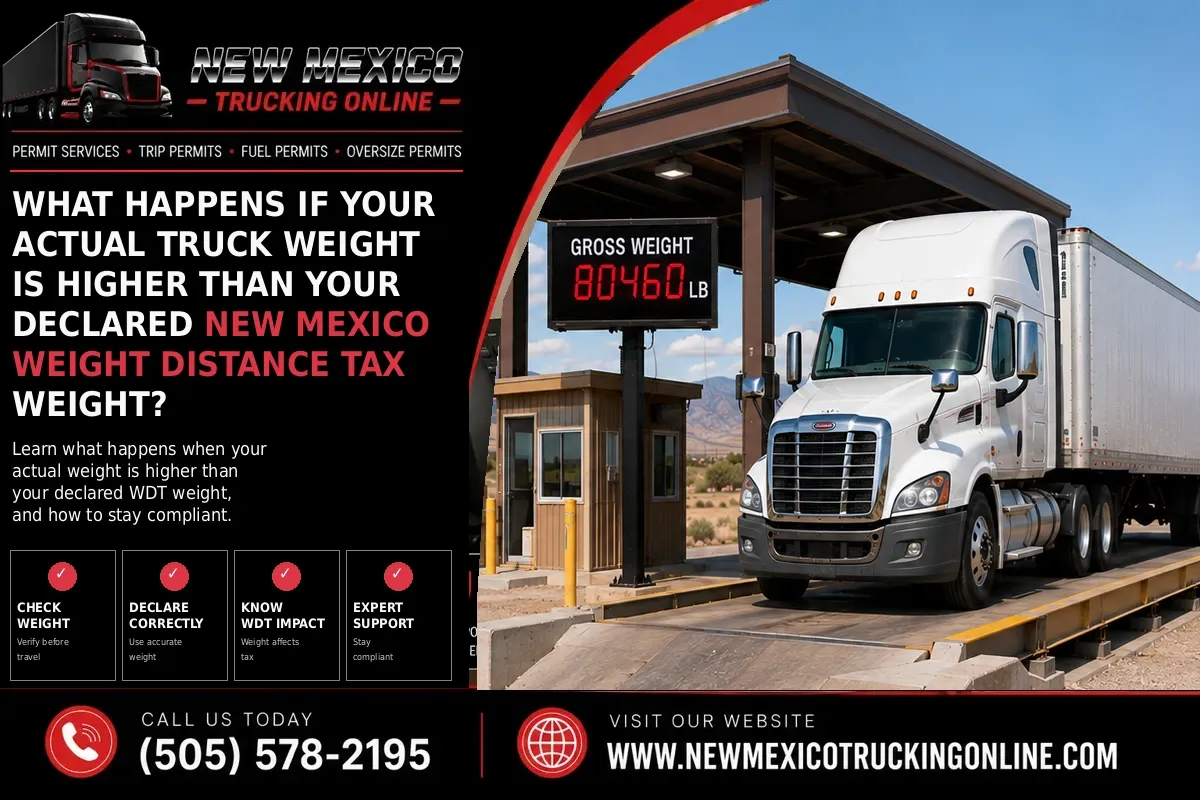
What Happens If Your Actual Truck Weight Is Higher Than Your Declared WDT Weight?
Table Of Contents
-
Introduction
-
What Is Declared Weight For New Mexico WDT?
-
What Happens If Your Actual Weight Is Higher?
-
Why The Difference Can Cause Problems
-
What Should You Do If Your Weight Changes?
-
How Weight Changes Can Affect WDT
-
How To Prevent Weight-Related WDT Problems
-
Common Mistakes To Avoid
-
Why Many Trucking Companies Choose Our Service
-
FAQ
Introduction
New Mexico Weight Distance Tax applies to qualifying commercial vehicles with a declared gross weight over 26,000 pounds. The tax is based on vehicle weight and the miles traveled on New Mexico roads.
A problem can occur when a truck operates at a gross or combined weight higher than the weight declared for registration. This may happen when a carrier accepts a heavier load, changes its trailer configuration, or underestimates the maximum weight at which the vehicle will operate.
New Mexico defines declared gross weight as the maximum gross vehicle or combined gross vehicle weight at which the vehicle or combination will operate during the registration period. Carriers should therefore make sure the declared weight accurately reflects their planned operations.
What Is Declared Weight For New Mexico WDT?
Declared gross weight is the maximum weight a carrier declares for the vehicle or combination for registration and fee purposes.
For New Mexico Weight Distance Tax, the declared weight is important because it determines the vehicle's applicable weight class.
The state requires qualifying vehicles to register for WDT and file quarterly returns. The declared weight should reflect the highest weight at which the vehicle is expected to operate during the registration period.
For a combination, carriers need to consider the complete operating combination rather than looking only at the tractor.
This means a trucking company should review its expected loads, trailer configuration, and normal operations before selecting its declared weight.
What Happens If Your Actual Weight Is Higher?
Operating a vehicle above its declared weight can create a compliance problem.
New Mexico's WDT instructions specifically state that a vehicle may not be operated on New Mexico highways at a gross vehicle weight higher than its declared gross weight.
For example, if a carrier declares a weight of 70,000 pounds but later loads the vehicle to 75,000 pounds, the carrier should not simply assume that the additional weight is acceptable because the difference is temporary.
The carrier should address the weight issue before operating at the higher weight.
Depending on the circumstances, operating above the declared weight can result in enforcement action, additional administrative work, and other consequences associated with failing to comply with New Mexico's weight-distance requirements.
Why The Difference Can Cause Problems
The declared weight is not just an administrative number on a registration record. It establishes the maximum weight at which the vehicle is declared to operate.
When the actual operating weight exceeds that amount, the carrier can face questions about whether the vehicle is properly registered and whether the applicable WDT requirements have been met.
Possible problems can include:
-
A weight-related violation
-
Inspection delays
-
Additional registration requirements
-
Tax-related issues
-
Administrative corrections
-
Compliance concerns
This can become especially important for carriers whose freight weights vary significantly from one trip to another.
A carrier that regularly hauls heavier loads should review its declared weight instead of repeatedly operating above the declared amount.
What Should You Do If Your Weight Changes?
If a trucking company discovers that a vehicle will operate at a higher weight than originally declared, it should address the issue before the heavier trip begins.
First, determine the expected gross vehicle weight or gross combination weight of the complete loaded combination.
Next, compare that figure with the current declared weight.
If the expected operating weight exceeds the declared amount, the carrier should determine what registration adjustment or other action is required before traveling at the higher weight.
Carriers should also review how the change affects their New Mexico Weight Distance Tax obligations.
It is much better to resolve a weight discrepancy before the vehicle enters New Mexico than to discover the problem during an inspection or after the vehicle has already traveled at the higher weight.
How Weight Changes Can Affect WDT
The amount of the New Mexico Weight Distance Tax is connected to the vehicle's weight and the miles traveled in the state.
New Mexico uses different mill rates depending on the applicable weight class and whether the operation qualifies for a particular haul classification.
As a result, changing the declared weight can affect the applicable WDT calculation.
This matters for carriers that frequently change the type or weight of freight they transport. A truck that normally carries lighter loads may occasionally be assigned a much heavier shipment.
Before accepting that load, the carrier should make sure the vehicle's declared weight is appropriate for the planned operation.
Accurate weight information also helps keep registration records and quarterly WDT reporting consistent.
How To Prevent Weight-Related WDT Problems
Trucking companies can reduce the risk of weight-related problems by reviewing their operations before registration and before dispatching heavier loads.
Carriers should:
-
Check the current declared weight.
-
Confirm the tractor and trailer configuration.
-
Determine the expected loaded weight.
-
Consider the heaviest planned operations.
-
Review WDT requirements when operations change.
-
Keep accurate weight records.
-
Make sure dispatch information matches registration records.
-
Review weight information before entering New Mexico.
A simple weight check before dispatch can prevent a much more complicated compliance problem later.
Fleet managers should also make sure dispatchers understand the declared weight limitations associated with each qualifying vehicle.
Common Mistakes To Avoid
Choosing A Weight Based Only On Typical Loads:
Consider the highest weight at which the vehicle is expected to operate.
Ignoring A Heavier Load Assignment:
A new shipment can increase the vehicle's actual operating weight.
Assuming A Temporary Increase Is Automatically Allowed:
Do not assume you can operate above the declared weight simply because the heavier load is occasional.
Forgetting The Trailer:
For a combination, consider the complete gross combination weight.
Waiting Until An Inspection:
Address weight differences before operating at the higher weight.
Failing To Keep Weight Records:
Maintain documentation that helps verify the weight of different loads.
Confusing Empty Weight With Declared Weight:
Declared gross weight concerns the maximum operating weight declared for registration, not simply the truck's unloaded weight.
Why Many Trucking Companies Choose Our Service
Many trucking companies choose New Mexico Trucking Online because managing Weight Distance Tax requirements can become more complicated when vehicle weights and hauling operations change.
Our experienced permit specialists help trucking companies with New Mexico Weight Distance Tax needs and provide support when carriers need assistance with registration and permit requirements.
With fast processing, 24/7 customer support, weekend and holiday availability, secure online applications, competitive pricing, and experienced permit specialists, New Mexico Trucking Online helps trucking companies manage their permit needs efficiently.
Keeping declared weight information accurate can help carriers reduce paperwork problems, avoid unnecessary delays, and maintain better control over their New Mexico operations.
Get your New Mexico Weight Distance Tax permit today.
FAQ
What happens if my truck weighs more than its declared WDT weight?
Operating above the declared weight can violate New Mexico requirements. The carrier should address the weight difference before operating at the higher weight.
Can I temporarily operate above my declared weight?
Do not assume that a temporary increase is allowed. The declared weight should reflect the maximum weight at which the vehicle or combination will operate during the registration period.
Why is declared weight important for WDT?
Declared weight determines the applicable weight class used for New Mexico Weight Distance Tax purposes.
What if I receive a heavier load than expected?
Determine the expected loaded weight and compare it with the vehicle's declared weight before traveling.
Does adding a trailer affect the declared weight?
Yes. For a combination, the applicable weight includes the complete vehicle combination.
Can changing my declared weight affect WDT?
Yes. A different declared weight can place the vehicle in a different WDT weight class and affect the applicable tax calculation.
Should I check my weight before entering New Mexico?
Yes. Confirm that the vehicle and load comply with the declared weight and applicable requirements before traveling.
How can I avoid declared-weight problems?
Review your heaviest expected operations, maintain accurate weight records, and make sure the declared weight reflects the maximum weight at which the vehicle will operate.
For more information, visit the New Mexico Motor Vehicle Division.