New Mexico WDT vs. Oregon Weight-Mile Tax: Which Requires More Mileage Records?
Table Of Contents
-
Introduction
-
Why Mileage Records Matter
-
New Mexico WDT Mileage Records
-
Oregon Weight-Mile Tax Mileage Records
-
Which Program Requires More Detail?
-
How Route Changes Affect Records
-
What Trucking Companies Should Keep
-
Common Mileage Recordkeeping Mistakes
-
How To Make Recordkeeping Easier
-
Why Many Trucking Companies Choose Our Service
-
FAQ
Introduction
The New Mexico WDT vs. Oregon Weight-Mile Tax comparison is especially useful for carriers operating in both states. New Mexico's Weight Distance Tax is based on vehicle weight and miles traveled on New Mexico roads, while Oregon's Weight-Mile Tax also depends on taxable distance and vehicle configuration.
So, which program requires more mileage records?
Oregon generally has more detailed distance-record requirements. Understanding that difference can help trucking companies create a recordkeeping process that supports both programs.
Why Mileage Records Matter
Mileage records support the tax calculations reported to the state. A carrier should be able to show how reported mileage was determined rather than relying on an estimate.
For New Mexico, carriers need records supporting miles traveled in the state. Oregon requires more detailed information that can be used to verify mileage, routes, taxable distance, and other operating details.
New Mexico WDT Mileage Records
New Mexico's Weight Distance Tax applies to qualifying commercial vehicles and is based on vehicle weight and miles traveled on New Mexico roads.
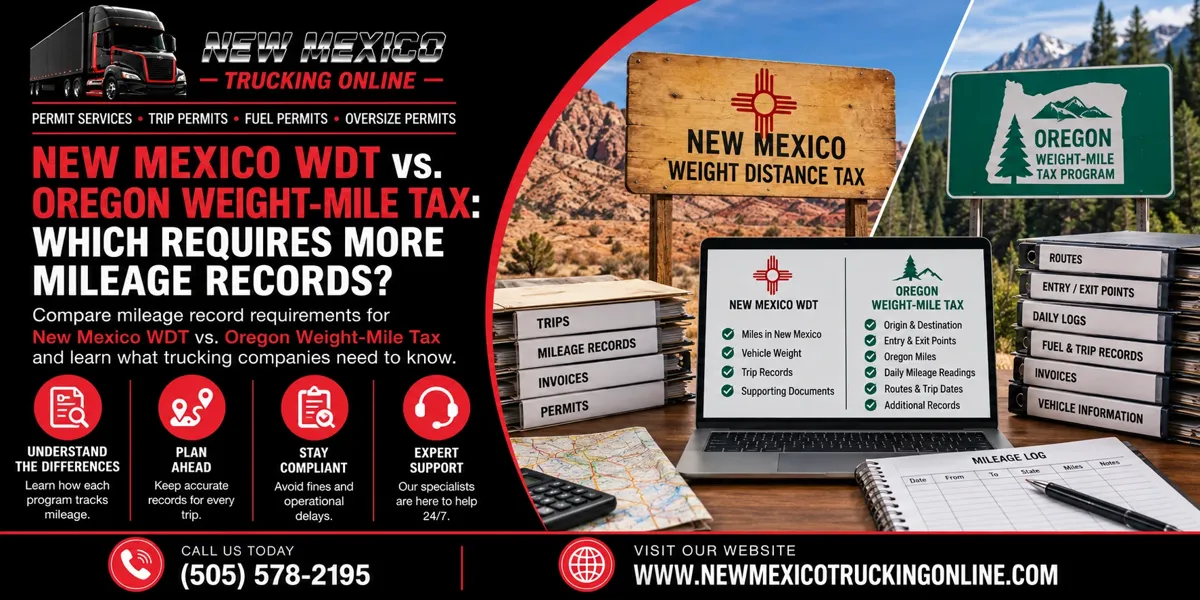
Carriers need reliable documentation supporting the New Mexico miles reported on their tax returns. Records can include accurate map mileage, odometer or hubodometer readings, and vehicle-specific logs. Vehicle itineraries can also identify trip origins, destinations, and routes.
Mileage records become especially important when a carrier claims special treatment, such as a one-way haul classification. The company should be able to support the mileage and circumstances behind the claim.
Oregon Weight-Mile Tax Mileage Records
Oregon has particularly detailed requirements for Weight-Mile Tax distance records.
Carriers generally need to document the origin and destination of each trip, Oregon entry and exit points, actual Oregon miles, pickup and delivery points, routes, trip dates, and daily beginning and ending mileage readings.
Additional information may be required depending on the operation. Records can include exempt miles, load tickets or bills of lading, monthly summaries of Oregon and taxable miles, and mileage by vehicle configuration.
Qualifying GPS and vehicle-tracking systems may also be used, but the records must contain required information, including location data, dates and times, mileage readings, calculated distance, and total Oregon mileage.
This makes Oregon's recordkeeping framework more detailed than simply recording a monthly mileage total.
Which Program Requires More Detail?
When comparing the New Mexico WDT vs. Oregon Weight-Mile Tax, Oregon generally requires more detailed mileage documentation.
New Mexico focuses on establishing miles traveled in New Mexico and maintaining records that support those reported miles. Records can be based on mileage calculations, odometer readings, or vehicle logs.
Oregon has a broader list of specified distance-record elements. Depending on the operation, carriers may need to document entry and exit points, routes, pickup and delivery locations, daily readings, taxable distance, exempt mileage, and vehicle configurations.
How Route Changes Affect Records
Changes during a trip can complicate mileage records.
A carrier may change its route because of weather, construction, customer instructions, or an additional pickup. The company should update its records to reflect the actual operation instead of keeping only the original planned mileage.
Vehicle changes can also affect documentation, particularly in Oregon when a carrier operates in multiple vehicle configurations.
For New Mexico operations, reported mileage should likewise be connected to the correct vehicle and supported by the underlying trip records.
Recording changes while the trip is happening is easier than reconstructing them later.
What Trucking Companies Should Keep
A practical recordkeeping system should capture enough information to support each state's reporting requirements.
For New Mexico operations, trucking companies should maintain records of New Mexico miles, vehicle information, trip details, and documentation supporting any special mileage treatment.
For Oregon operations, carriers should be prepared to maintain:
-
Origin and destination
-
Oregon entry and exit points
-
Actual Oregon miles
-
Pickup and delivery points
-
Routes traveled
-
Trip dates
-
Beginning and ending mileage readings
-
Exempt miles when applicable
-
Load tickets or bills of lading
-
Monthly mileage summaries
Electronic records can make it easier to locate a specific trip when preparing a report or responding to a review.
Common Mileage Recordkeeping Mistakes
One common mistake is recording only total state mileage without keeping the trip information that supports the total.
Another is failing to update records when the actual route differs from the original dispatch plan.
Carriers can also create problems by mixing mileage between vehicles or failing to identify which truck generated the reported miles.
For Oregon operations, companies should pay particular attention to information required for electronic tracking and multiple vehicle configurations.
For New Mexico operations, reported mileage should also be supported by adequate records.
How To Make Recordkeeping Easier
The best approach is to make mileage tracking part of normal dispatch and accounting procedures.
Drivers should record trip information while operations are taking place instead of waiting until the end of a reporting period. Dispatch can document route changes and vehicle assignments, while compliance staff can use those records when preparing tax reports.
Separate electronic records for New Mexico and Oregon operations can reduce confusion when one truck travels through both states.
Companies using electronic tracking should also verify that their system captures the information required for the applicable program.
A consistent process reduces missing information and makes future reviews easier.
Why Many Trucking Companies Choose Our Service
Many trucking companies choose New Mexico Trucking Online because multi-state tax requirements can make mileage reporting and permit compliance difficult to manage.
Our service helps simplify the process with experienced permit specialists, fast processing, secure online applications, competitive pricing, and convenient customer support.
We help trucking companies prepare for New Mexico requirements so they can spend less time dealing with administrative details and more time managing their operations.
Stay Compliant With Your WDT Today.
FAQ
Which Requires More Mileage Records, New Mexico WDT Or Oregon Weight-Mile Tax?
Oregon generally requires more detailed distance records, including routes, entry and exit points, mileage readings, taxable distance, and other trip details.
Does New Mexico WDT Require Mileage Records?
Yes. Carriers need reliable records supporting the New Mexico mileage reported for Weight Distance Tax purposes.
Does Oregon Require Daily Mileage Readings?
Yes. Oregon's Weight-Mile Tax recordkeeping requirements include daily beginning and ending mileage readings for each vehicle.
Can Electronic Tracking Be Used For Oregon Records?
Yes. Qualifying vehicle-tracking and GPS systems may be used when their records meet Oregon's requirements.
How Long Should Oregon Weight-Mile Tax Records Be Kept?
Oregon requires Weight-Mile Tax records to be retained for three years unless otherwise authorized.
Why Are Accurate Mileage Records Important?
Accurate records support reported mileage and help demonstrate compliance during a review or audit.
For more information, visit the New Mexico Taxation and Revenue Department.