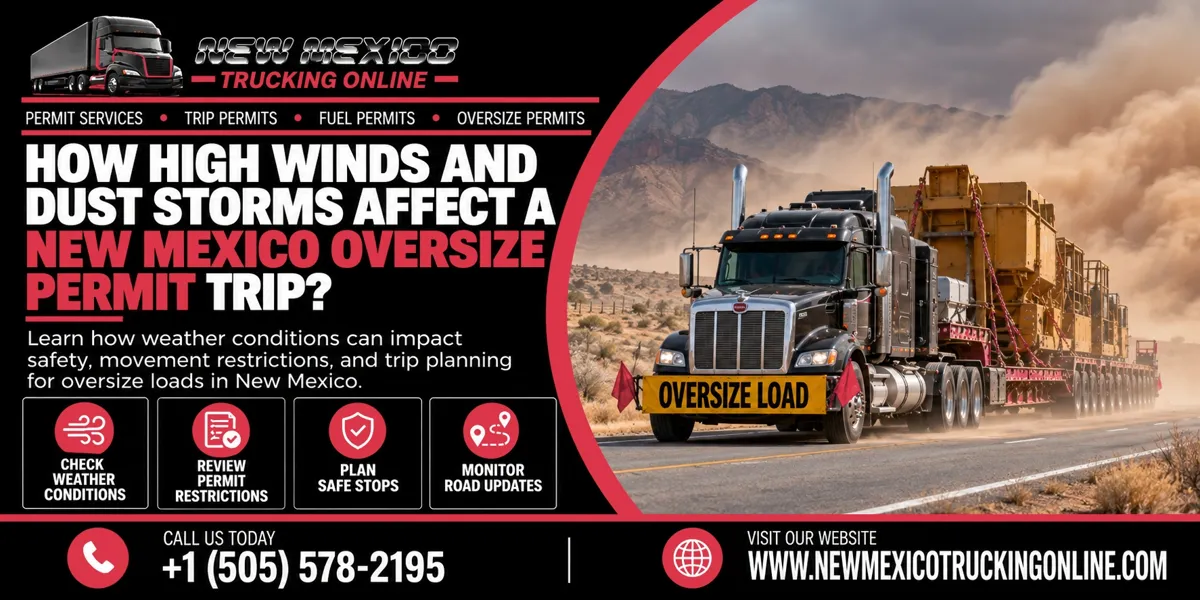
How High Winds and Dust Storms Affect a New Mexico Oversize Permit Trip
Table Of Contents
-
Introduction
-
Why Wind and Dust Are Serious Risks
-
New Mexico Weather Rules for Oversize Moves
-
What to Do Before Departure
-
How to Respond to Blowing Dust on the Road
-
Handling Delays and Restarting the Trip
-
Mistakes to Avoid
-
Why Many Trucking Companies Choose Our Service
-
FAQ
Introduction
High winds and dust storms can turn an oversize move into a serious safety concern. A wide or tall load can catch crosswinds, sway, or become harder to control. Blowing dust can reduce visibility with little warning.
Before beginning a trip under a New Mexico Oversize Permit, check the forecast, review movement restrictions, and plan how to stop or delay safely. A permit does not make every weather condition safe.
Why Wind and Dust Are Serious Risks
Crosswinds can push a high-profile trailer or load sideways and make lane keeping difficult. Gusts may strengthen in exposed areas or when a truck leaves shelter. Shifting cargo can make control harder.
Dust can suddenly hide traffic, lane markings, stopped vehicles, and road closures. Following too closely or maintaining normal speed leaves less time to react. Escort drivers may also lose sight of the permitted vehicle.
Oversize vehicles need more maneuvering room and may have fewer safe places to pull off.
New Mexico Weather Rules for Oversize Moves
New Mexico’s oversize and overweight regulations define inclement weather to include dust, visibility below 1,000 feet, and, for oversize vehicles, wind speeds of 25 miles per hour or more when measured by specified official sources. The regulations generally prohibit movement during inclement weather. A special permit’s daylight or continuous-movement allowance does not automatically authorize travel in unsafe weather.
Do not treat strong winds or blowing dust as a minor scheduling issue. Check the New Mexico Oversize Permit conditions and contact the relevant authority if unclear. Conditions below the threshold can still be dangerous depending on load height, width, shape, and stability.
What to Do Before Departure
1. Check official forecasts and road updates. Review wind advisories, dust-storm warnings, and road notices before dispatch and again near departure. Conditions can change quickly, so check the state road-information service for closures and alerts.
2. Review the permit conditions. Confirm route, movement hours, escort requirements, and special instructions. Continuous-movement permission does not override weather restrictions.
3. Inspect the load and equipment. Check load securement, flags, warning lights, and escort communications. Resolve any concern about load stability before leaving.
4. Agree on a stop-and-delay plan. Agree on communication steps and identify safe stopping areas. Do not rely on an unverified shoulder or narrow turnout.
How to Respond to Blowing Dust on the Road
If dust is approaching, avoid driving into the storm. Do not wait until visibility is nearly gone to decide what to do. If safe, leave the highway completely and stop away from traffic. Never stop in an active lane.
If caught in a dust storm, check nearby traffic, slow down, and move away from travel lanes as safely as possible. New Mexico road-safety guidance advises drivers who have stopped safely off the roadway to turn off all vehicle lights, including emergency flashers, set the parking brake, take their foot off the brake, remain inside with seat belts fastened, and wait for conditions to improve. Lights can cause other drivers to follow them into a stopped vehicle when visibility is poor.
High-profile vehicles should be especially cautious in strong winds. If the truck starts to sway, the load appears unstable, or steering becomes difficult, stop at a safe location rather than trying to make up time. Follow instructions from law enforcement or transportation officials, including any road closure or movement restriction.
Handling Delays and Restarting the Trip
Tell dispatch and escorts the location and reason for stopping. Update the customer if timing changes. Record the time, location, alerts, road restrictions, and official instructions.
Before moving again, recheck weather and road conditions, inspect securement and warning equipment, and confirm the route is open. If a road closure or other event requires a route change, do not improvise a detour with an oversize load. Obtain direction or approval from the appropriate authority when required and ensure the alternate route is suitable for the load.
Resume only when conditions meet the applicable rules, the driver can control the vehicle safely, and all permit conditions can be followed. If there is uncertainty, contact the permit authority or enforcement officials before restarting.
Mistakes to Avoid
Do not assume a permit authorizes travel in all weather or treat 25 mph as a guarantee that lower winds are safe. Gusts and load characteristics can create danger sooner.
Do not follow trucks into a dust cloud, stop in a traffic lane, or ignore escorts, closures, and officials to preserve an appointment.
Why Many Trucking Companies Choose Our Service
Planning an oversize move requires accurate vehicle and load details and a clear understanding of permit conditions. New Mexico Trucking Online helps carriers navigate New Mexico permit applications and organize trip information.
Our service aims to simplify applications, reduce paperwork confusion, and provide practical support. Preparation cannot control weather, but organized permit information helps carriers respond when conditions disrupt a move.
FAQ
At what wind speed does New Mexico define inclement weather for oversize loads?
The regulations define wind speeds of 25 mph or more, measured by specified official sources, as inclement weather for oversize vehicles and loads. Lower speeds can still be unsafe.
Can I keep moving if my permit allows continuous movement?
Not automatically. New Mexico’s rules state that continuous movement does not include movement during inclement weather. Check permit conditions and official instructions.
What should a driver do if a dust storm suddenly reduces visibility?
Avoid entering the dust storm, move fully away from traffic if it is safe to do so, and follow official safety guidance. Never stop in an active travel lane.
Should dispatch be told when weather stops an oversize trip?
Yes. Tell dispatch and escorts where you stopped, share the reason, and document alerts or official instructions. Update the customer if timing changes.
For more information, visit the New Mexico Department of Public Safety.