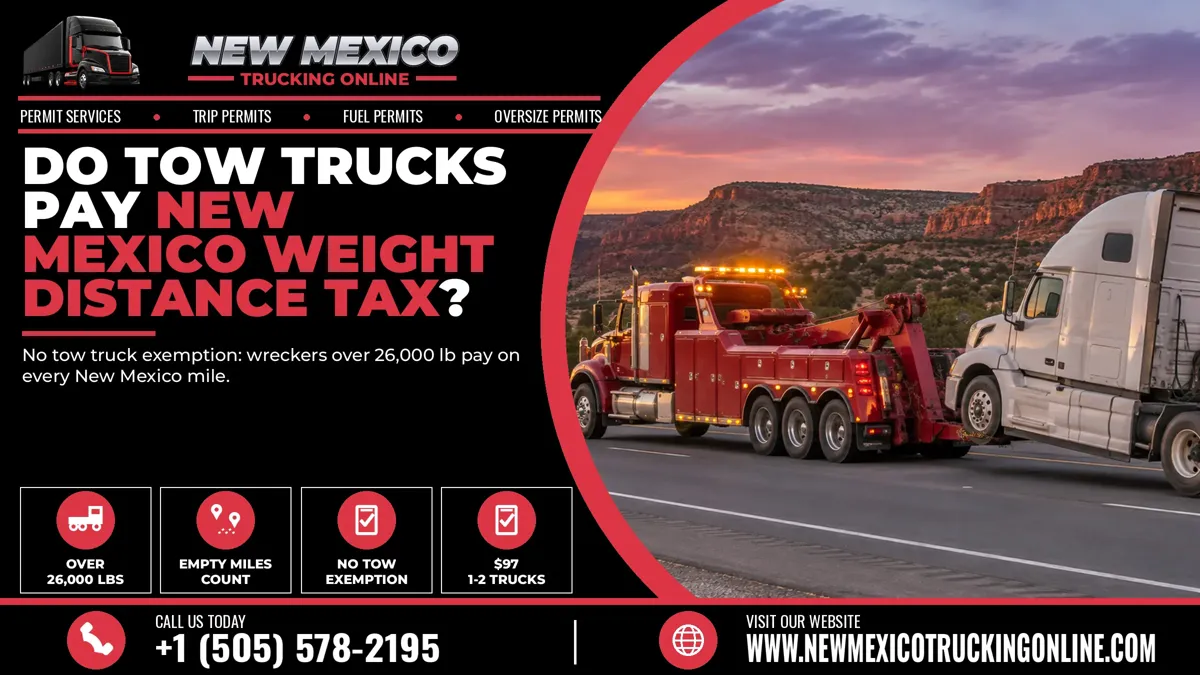
Do Tow Trucks Pay New Mexico Weight Distance Tax?
Table Of Contents
-
Introduction
-
The Short Answer
-
What New Mexico Law Says
-
Why There's No Tow Truck Exemption
-
Light-Duty Tow Trucks and Rollbacks
-
Medium and Heavy Wreckers
-
How Declared Weight Works for Tow Trucks
-
Out-of-State Tow Trucks
-
Empty Miles and Recovery Runs
-
Quick Checklist
-
Common Mistakes to Avoid
-
Why Many Trucking Companies Choose Our Service
-
FAQ
Introduction
Tow trucks spend their days on New Mexico highways, clearing wrecks on I-25 and I-40, moving broken-down trucks to shops and hauling equipment across the state. Because towing is a service business and not freight hauling, many operators assume the New Mexico Weight Distance Tax doesn't apply to them.
That assumption can be costly. This guide explains when tow trucks pay the New Mexico Weight Distance Tax, which ones usually don't, and how weight decides most cases.
The Short Answer
There's no tow truck exemption in New Mexico law.
-
A tow truck with a declared gross weight or gross vehicle weight over 26,000 pounds pays the New Mexico Weight Distance Tax on its New Mexico miles.
-
A tow truck at 26,000 pounds or less is generally outside the tax.
Most light-duty wreckers and rollbacks fall under the line. Most heavy wreckers and rotators are well over it.
What New Mexico Law Says
The New Mexico Weight Distance Tax is set under Chapter 7, Article 15A NMSA 1978 and run by the New Mexico Taxation and Revenue Department. The tax is charged on each mile a vehicle travels on New Mexico highways, at a rate based on its declared gross weight.
-
The rate schedule in Section 7-15A-6 starts at 26,001 pounds.
-
The rate per mile rises with weight.
-
Carriers register each truck, keep an annual electronic permit and file returns for their New Mexico miles.
Why There's No Tow Truck Exemption
Section 7-15A-5 lists only four exemptions:
-
School buses,
-
Buses used only for agricultural laborers,
-
Buses run by religious or nonprofit charitable organizations, and
-
Commercial vehicles operating only within ten miles of the Mexico border while crossing it.
Tow trucks aren't on that list. Some states give wreckers special treatment, but New Mexico's law doesn't. That means a tow truck is taxed the same way as any other heavy truck once it's over the weight line.
Light-Duty Tow Trucks and Rollbacks
Light-duty wreckers and car carrier rollbacks are usually built on Class 4 to Class 6 chassis.
-
Many have a gross vehicle weight rating between 14,000 and 26,000 pounds.
-
If the declared gross weight stays at 26,000 pounds or less, the truck is generally outside the New Mexico Weight Distance Tax.
-
Check the door sticker and the registration. A rollback rated at 26,001 pounds or more is in the tax.
Don't guess from the truck's size. The number on paper decides.
Medium and Heavy Wreckers
Medium-duty wreckers, heavy wreckers and rotators are built to lift and tow loaded tractor-trailers and buses. They're almost always over the line.
-
Heavy wreckers often run on tandem or tri-axle chassis rated well over 26,000 pounds.
-
Rotators can be rated far heavier, which puts them in the higher rate brackets.
-
These trucks need a New Mexico Weight Distance Tax account, an annual permit and regular returns.
If your fleet mixes light and heavy units, check each truck separately. One account can cover every taxable truck in the fleet.
How Declared Weight Works for Tow Trucks
The tax rate depends on the declared gross weight, the heaviest weight at which the truck will operate.
-
For a tow truck, that can include the weight it carries or lifts during a tow, not just its empty weight.
-
A wrecker that tows heavy trucks should declare a weight that matches its real work.
-
Declaring too low can lead to back tax and penalties if the truck is found heavier.
If you aren't sure how to declare a wrecker that tows vehicles of very different sizes, check before you register instead of after an audit.
Out-of-State Tow Trucks
Heavy wreckers from Texas, Arizona, Colorado and other states often come into New Mexico for big recoveries or long tows.
-
An out-of-state tow truck over 26,000 pounds owes the New Mexico Weight Distance Tax on its New Mexico miles.
-
A carrier with a New Mexico account reports those miles on its return.
-
A truck that isn't registered for New Mexico can use a New Mexico trip permit, which charges a trip tax in lieu of registration and the weight distance tax for that trip.
Empty Miles and Recovery Runs
Tow trucks drive a lot of miles with nothing on the hook, heading to a scene or returning to the yard.
-
Empty miles count. The tax is based on miles traveled on New Mexico highways, loaded or not.
-
Keep trip logs or ELD data for every run, including calls that were canceled on the way.
-
Record New Mexico miles separately if the truck also works in other states.
Good records make returns easier and protect you in an audit.
Quick Checklist
-
Check the Declared Gross Weight. Over 26,000 pounds means the tax applies.
-
Check Each Truck. Light and heavy units are treated differently.
-
Declare Realistic Weight. Match the weight the truck actually works at.
-
Open an Account. Taxable tow trucks need an account and annual permit.
-
Track Every Mile. Empty runs count too.
-
Out-of-State Truck? Use your account or a trip permit.
Common Mistakes to Avoid
-
Assuming towing is exempt. New Mexico has no tow truck exemption.
-
Using the empty weight. The declared gross weight decides.
-
Skipping empty miles. Every mile on New Mexico highways counts.
-
Treating the whole fleet the same. Check each truck's weight.
-
Missing zero-mile returns. Registered trucks file even when they don't run in New Mexico.
Why Many Trucking Companies Choose Our Service
New Mexico Trucking Online helps towing companies find out which trucks owe the New Mexico Weight Distance Tax, sets up accounts for the ones that do and keeps every return on time.
-
1-2 Trucks: $97
-
3-4 Trucks: $197
-
5-6 Trucks: $297
-
7-8 Trucks: $397
-
9-10 Trucks: $497
-
11+ Trucks: Contact Us directly!
We provide support 24/7 and also work weekends and holidays.
or
FAQ
Do tow trucks pay the New Mexico Weight Distance Tax?
Yes, if the declared gross weight or gross vehicle weight is over 26,000 pounds.
Is there a tow truck exemption in New Mexico?
No. The exemptions in Section 7-15A-5 don't include tow trucks.
Do light-duty rollbacks pay the tax?
Usually not, if they're declared at 26,000 pounds or less.
Do empty tow runs count?
Yes. Every mile on New Mexico highways counts, loaded or empty.
What about out-of-state wreckers?
They owe the tax on New Mexico miles, through an account or a New Mexico trip permit.
For more information, visit the New Mexico Taxation and Revenue Department.