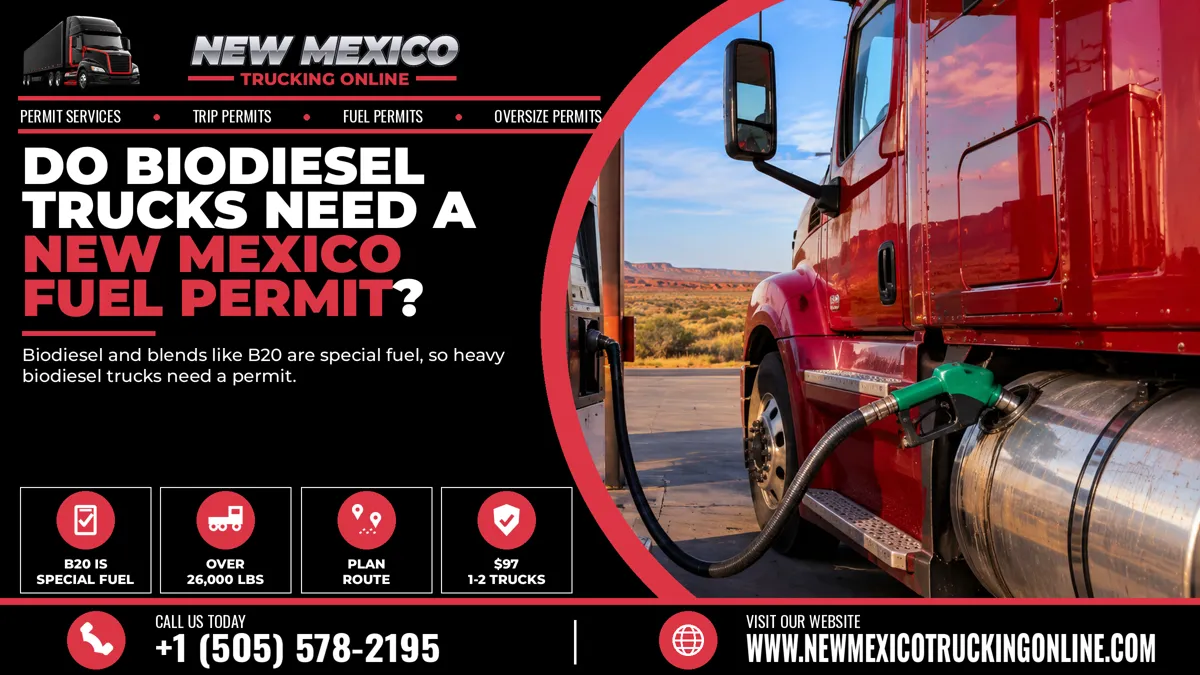
Do Biodiesel Trucks Need a New Mexico Fuel Permit?
Table Of Contents
-
Introduction
-
The Short Answer
-
What New Mexico Law Says About Biodiesel
-
Who Needs a New Mexico Fuel Permit
-
Blends Like B5, B20, and B100
-
How a Biodiesel Truck Gets Covered
-
What Else a Biodiesel Truck Needs in New Mexico
-
Common Mistakes to Avoid
-
Why Many Trucking Companies Choose Our Service
-
FAQ
Introduction
Biodiesel is a common choice for carriers that want lower emissions without changing engines. Many diesel trucks already run on blends like B5 or B20, and some fleets fill up with higher blends whenever they can find them.
Because biodiesel is made from plant oils or animal fats instead of crude oil, some carriers assume it is treated differently from regular diesel. When a biodiesel truck heads into New Mexico, the question is simple: does it still need a New Mexico Fuel Permit? The law gives a clear answer, and this guide explains it.
The Short Answer
Yes. If the truck is over 26,000 pounds and is not covered by IFTA or New Mexico registration, a biodiesel truck needs a New Mexico Fuel Permit just like a regular diesel truck.
New Mexico law lists biodiesel and blended biodiesel as special fuel. A truck running on biodiesel is using special fuel, so the same permit rules that apply to diesel apply to it.
What New Mexico Law Says About Biodiesel
New Mexico's fuel permit rules are part of the Special Fuels Supplier Tax Act, NMSA 7-16A. Section 7-16A-2 defines special fuel to include:
-
Diesel-engine fuel
-
Biodiesel and blended biodiesel
-
Kerosene
when used to power a motor vehicle. The same definition excludes gasoline, propane, compressed or liquefied natural gas, and aviation fuels.
Biodiesel is named directly, so there is no gray area. It does not matter that it comes from a renewable source. In New Mexico, it is special fuel.
Who Needs a New Mexico Fuel Permit
Under NMSA 7-16A-2, a special fuel user is a registrant, owner, or operator of a motor vehicle using special fuel with a gross vehicle weight of more than 26,000 pounds.
Section 7-16A-19 says a special fuel user whose vehicle is not registered with the department must get one of these from the New Mexico Department of Transportation before operating on New Mexico highways:
-
A temporary special fuel user permit, valid for one calendar day or for one entry into and one exit out of New Mexico, or
-
A border crossing special fuel user permit for certain Mexico-registered vehicles near the border.
Section 7-16A-19 also says it is a violation of the act to act as a temporary special fuel user without a valid permit.
Blends Like B5, B20, and B100
Carriers often ask whether the blend percentage makes a difference. It doesn't. The definition covers both biodiesel and blended biodiesel, so every common blend counts as special fuel:
-
B5 and B10. Mostly petroleum diesel, with a small share of biodiesel. Still special fuel.
-
B20. A popular fleet blend. Still special fuel.
-
B100. Pure biodiesel. Still special fuel.
A truck switching between regular diesel and biodiesel during a trip is using special fuel the whole time. The permit question stays the same no matter which pump it uses.
How a Biodiesel Truck Gets Covered
-
Check the Weight. If the truck's gross vehicle weight is more than 26,000 pounds, it can be a special fuel user.
-
Check IFTA. A truck with valid IFTA credentials reports its New Mexico miles and fuel on IFTA returns instead of buying a temporary permit.
-
Check Registration. The temporary permit rule in 7-16A-19 applies to vehicles that are not registered with the department.
-
Get the Permit Before Entry. If the truck is not covered, get a New Mexico Fuel Permit before it travels on New Mexico highways.
-
Watch the Time Limit. The permit is good for one calendar day or one entry and one exit, so plan longer trips carefully.
What Else a Biodiesel Truck Needs in New Mexico
The fuel permit is only one part of the picture. A heavy biodiesel truck may also need:
-
Weight Distance Tax (WDT). New Mexico imposes the weight distance tax on commercial vehicles with a declared gross vehicle weight over 26,000 pounds, regardless of fuel type.
-
Registration or a trip permit. A truck without proper registration for New Mexico may need a trip permit.
-
Port of entry stops. Commercial vehicles must stop at operating ports of entry for clearance.
-
Federal requirements. USDOT number, UCR, and IRS Form 2290 depend on the operation and weight, not the fuel.
Common Mistakes to Avoid
-
Treating biodiesel as an alternative fuel exemption. New Mexico names biodiesel as special fuel. There is no exemption for renewable diesel blends.
-
Assuming a low blend doesn't count. B5 and B20 are blended biodiesel, which is special fuel.
-
Confusing biodiesel with natural gas. Propane, CNG, and LNG are excluded from special fuel. Biodiesel is not.
-
Forgetting the time limit. One permit covers one calendar day or one entry and one exit.
-
Skipping the weight distance tax. That tax depends on weight, not fuel.
Why Many Trucking Companies Choose Our Service
New Mexico Trucking Online helps carriers running diesel and biodiesel trucks get the right New Mexico Fuel Permit before they reach the state line. We check the truck's weight, fuel, and route so every unit has the right paperwork at the port of entry.
-
1-2 Trucks: $97
-
3-4 Trucks: $197
-
5-6 Trucks: $297
-
7-8 Trucks: $397
-
9-10 Trucks: $497
-
Each additional 2 trucks: +$100
-
1001+ Trucks: Contact Us directly!
We provide support 24/7 and also work weekends and holidays.
or
FAQ
Do biodiesel trucks need a New Mexico Fuel Permit?
Yes, if they are over 26,000 pounds and not covered by IFTA or New Mexico registration. Biodiesel is special fuel under NMSA 7-16A-2.
Does a B20 blend count as special fuel?
Yes. New Mexico law covers both biodiesel and blended biodiesel.
How long is a New Mexico Fuel Permit valid?
It is valid for one calendar day or for one entry into and one exit out of New Mexico.
Do I need a permit if my truck has IFTA?
No. A truck with valid IFTA credentials reports its New Mexico fuel use on IFTA returns.
Does a biodiesel truck still owe weight distance tax?
It can. The weight distance tax applies to commercial vehicles over 26,000 pounds declared gross weight, regardless of fuel.
For more information, visit the New Mexico Motor Vehicle Division.