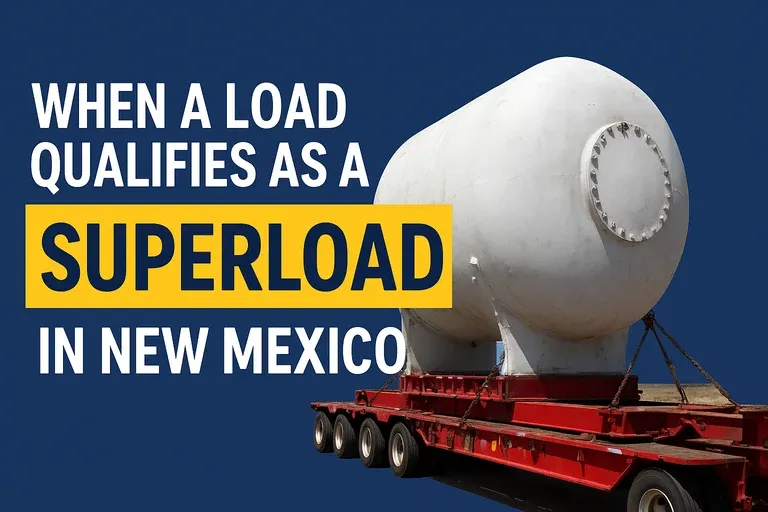
What Is a Superload in New Mexico?
A Superload is a load so large or heavy that it exceeds the typical dimensional or weight thresholds allowed under a standard OS/OW permit. These loads require additional approval from the New Mexico Department of Transportation (NMDOT) Oversize/Overweight Permit Office.
While exact thresholds can vary depending on roads, bridges, and districts, Superloads typically trigger when a load exceeds one or more of the following:
Superload Thresholds in New Mexico
1. Extreme Width
A load may qualify as a superload when it exceeds 20 feet in width.
Loads this wide often require:
-
Traffic control planning
-
Pilot / escort vehicles
-
Route-specific engineering review
2. Extreme Height
Loads over 17 feet high usually fall into Superload territory.
The state must ensure the route has:
-
Adequate bridge clearance
-
Utility line clearance
-
No low structures or tunnels
These loads often require utility companies to lift or move power lines.
3. Excessive Length
New Mexico typically flags loads longer than 120 feet as superloads.
Reasons include:
-
Turning radius limitations
-
Geometric road constraints
-
Need for detailed route planning
Longer combinations may also require multiple escort vehicles.
4. Excessive Weight
Heavy loads become Superloads when they exceed:
-
Over 200,000 lbs. gross vehicle weight, or
-
Exceed axle/bridge formula limits by a large margin
Very heavy loads require:
-
Bridge engineering analysis
-
Proof of vehicle configuration
-
Equipment drawings
-
Possible physical route surveys
This is the most common reason a load becomes a Superload in New Mexico.
Why Superloads Require Special Review
NMDOT must ensure the load can safely travel the selected route without:
-
Damaging roads or bridges
-
Blocking traffic for extended periods
-
Interfering with utilities
-
Creating safety hazards in tight areas
Superloads often require:
-
Engineering analysis
-
Special bridge reviews
-
Detailed route surveys
-
Traffic control coordination
-
Additional pilot cars
-
Temporary road closures
These steps help protect the infrastructure and public safety.
Permit Application Requirements for Superloads
Carriers moving a Superload in New Mexico must typically provide:
-
Complete vehicle + trailer + load dimensions
-
Axle weights and axle spacing diagrams
-
Overall weight documentation
-
Routing requests or preferences
-
Escort vehicle plans
-
Engineering drawings for extremely heavy loads
-
Certificate of insurance meeting state requirements
Because review is more complex, processing usually takes longer than standard permits.
How Long Does Superload Approval Take?
Standard OS/OW permits in New Mexico can be issued same-day, but Superloads often require:
-
3–10 days for moderate-size superloads
-
Several weeks for extremely heavy or high-impact hauls
Carriers should always plan ahead.
When Your Load Becomes a Superload (Common Scenarios)
Your load will likely be classified as a Superload in these situations:
-
Moving refinery equipment such as drums or compressors
-
Hauling industrial transformers
-
Transporting wind turbine blades or tower sections
-
Moving mining or construction machinery
-
Oversized manufactured tanks or vessels
-
Modular buildings with extreme dimensions
If any measurement seems close to the state limit, assume a Superload review will be required.
Tips for Avoiding Delays on Superloads
-
Start the permit application early
-
Provide exact measurements — not estimates
-
Include accurate axle spacing and weight charts
-
Work with an experienced permitting service
-
Coordinate with pilot car companies in advance
-
Be flexible with travel dates
Proper planning prevents costly downtime.
Final Thoughts
Superloads in New Mexico involve added complexity, but with the right preparation, they can be moved safely and efficiently. Whenever your load pushes extreme weight or size boundaries, expect specialized review and build extra time into your schedule.