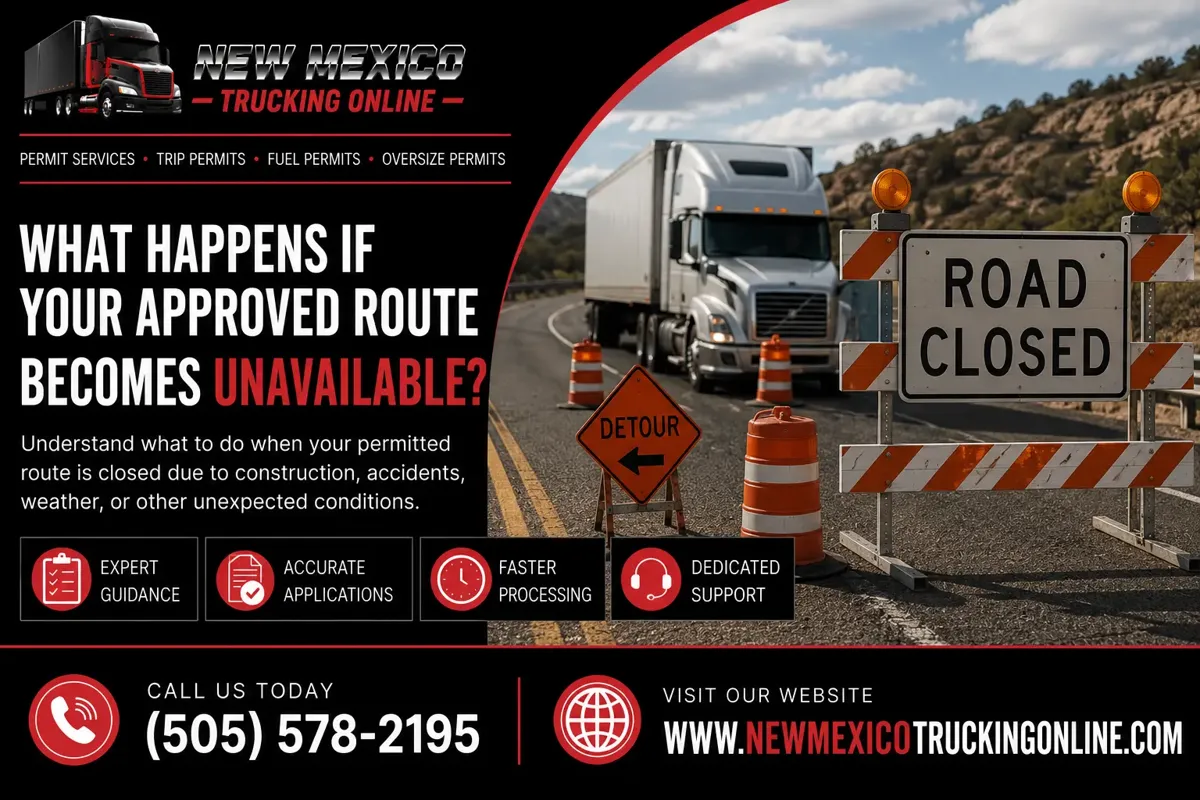
What Happens If Your Approved Route Becomes Unavailable?
Table Of Contents
-
Introduction
-
Why The Approved Route Matters
-
What Can Make An Approved Route Unavailable?
-
Can You Simply Take Another Route?
-
What Should Dispatch Do?
-
What Should The Driver Do?
-
How To Prevent Route Problems
-
Why Many Trucking Companies Choose Our Service
-
FAQ
Introduction
Moving an oversized or overweight load through New Mexico requires careful planning. In addition to obtaining the correct New Mexico Oversize Permit, trucking companies need to follow the conditions of the approved movement, including the authorized route.
Sometimes, the approved route may become unavailable after the permit has already been issued. A highway could close because of construction, an accident could block traffic, severe weather could affect travel, or an unexpected restriction could make part of the route unusable.
When this happens, the driver should not simply choose another road and continue. An alternate route may not be appropriate for the dimensions, weight, or configuration of the permitted vehicle.
Understanding what to do when an approved route becomes unavailable can help trucking companies respond quickly while reducing the risk of unnecessary delays or compliance issues.
Why The Approved Route Matters
The route listed for an oversized movement is an important part of the permit conditions. An oversized or overweight vehicle may require a specific route because of bridge limitations, road widths, clearances, construction, weight restrictions, or other roadway conditions.
A route that is suitable for a standard truck may not be suitable for an oversized load.
For example, an alternate road could have a low bridge, a narrow section, a restricted structure, or another condition that prevents the permitted vehicle from safely completing the movement.
This is why trucking companies should treat the approved route as part of the authorization rather than simply as a suggested navigation route.
What Can Make An Approved Route Unavailable?
An approved route can become unavailable for many reasons, sometimes with little warning.
Common situations include:
-
Road construction or maintenance
-
Traffic accidents
-
Emergency closures
-
Severe weather
-
Bridge restrictions
-
Road damage
-
Temporary weight restrictions
-
Police or emergency activity
-
Unexpected clearance issues
-
Local roadway restrictions
The problem can occur before the driver starts the trip or after the oversized load is already moving.
When a route becomes unavailable, the carrier should identify the problem and determine what alternative is appropriate before changing the planned route.
Can You Simply Take Another Route?
A driver should not assume that any alternate route can be used for an oversized movement.
Even when another road appears to be faster or more convenient, it may not have been approved for the specific vehicle and load. The alternate road may also have restrictions that are not obvious to the driver.
Trucking companies should avoid relying solely on ordinary navigation applications when moving under a New Mexico Oversize Permit.
Instead, dispatch should review the situation and determine whether the route can be changed through the appropriate process.
The driver should not make an independent route change simply because the original route is blocked.
What Should Dispatch Do?
When dispatch learns that an approved route has become unavailable, the first step is to determine the exact location of the problem.
Dispatch should obtain the driver's current location and identify the portion of the route that is blocked or restricted.
The company should then review important information about the movement, including:
-
Current truck location
-
Load dimensions
-
Gross weight
-
Axle configuration
-
Current destination
-
Original approved route
-
Location of the closure
-
Potential alternate route
-
Expected travel conditions
If the movement needs an alternate route, dispatch should determine whether additional approval or permit action is required before instructing the driver to continue.
Clear communication between dispatch, the driver, and the permit specialist can help prevent confusion when conditions change.
What Should The Driver Do?
If the driver encounters a closure or another problem on the approved route, the driver should contact dispatch as soon as it is safe to do so.
The driver should provide the exact location and explain what is preventing the truck from continuing.
The driver should not take an unfamiliar alternate route simply to avoid the delay. An unauthorized route could create additional compliance and safety concerns.
The driver should also avoid changing the load configuration or removing required safety equipment to make an alternate route possible.
Once dispatch determines the appropriate solution, the driver should follow the updated instructions and remain in communication throughout the remainder of the trip.
How To Prevent Route Problems
The best way to reduce route problems is to prepare for them before the truck leaves.
Before starting a permitted move, dispatch should review the approved route and confirm that the current road conditions appear suitable. The company should also make sure the driver understands the route and knows who to contact if an unexpected closure occurs.
Before departure, verify:
-
The approved route
-
Load dimensions and weight
-
Travel dates
-
Travel times
-
Escort requirements
-
Known construction areas
-
Potential clearance concerns
-
Contact information for dispatch
Trucking companies should also keep permit and route information organized by vehicle and trip. This makes it easier to review the authorization quickly if something changes during the move.
A clear process for handling closures can help the company respond without forcing the driver to make an unauthorized decision.
Why Many Trucking Companies Choose Our Service
Many trucking companies choose New Mexico Trucking Online because oversized moves can become complicated when routes, schedules, or road conditions change unexpectedly. Our service helps simplify the permitting process with fast processing, experienced permit specialists, secure online applications, 24/7 customer support, and weekend and holiday availability.
Our team can assist trucking companies when they need to review permit requirements or address a route-related issue before continuing a permitted movement.
Our goal is to make the permitting process more convenient so trucking companies can spend less time dealing with paperwork and more time keeping their operations moving.
Apply with New Mexico Trucking Online today.
FAQ
What Should I Do If My Approved New Mexico Oversize Route Is Closed?
Contact dispatch immediately and provide the driver's location and details about the closure. Do not automatically take another route.
Can A Driver Choose An Alternate Route?
The driver should not assume that an alternate route is authorized. The carrier should review the proposed route and determine what approval is required.
What Information Should Dispatch Review?
Dispatch should review the truck's location, load dimensions, weight, axle configuration, destination, closure location, and potential alternate route.
What If The Closure Happens During The Trip?
The driver should contact dispatch and wait for instructions. The carrier should determine the appropriate solution before changing the approved route.
Can A Route Change Affect Other Permit Conditions?
Yes. A route change can affect travel times, escorts, clearances, and other conditions associated with the permitted movement.
How Can Trucking Companies Prepare For Route Closures?
Review the approved route before departure, monitor conditions when possible, keep permit information accessible, and establish a clear process for handling unexpected closures.
For more information, visit the New Mexico Department of Transportation.