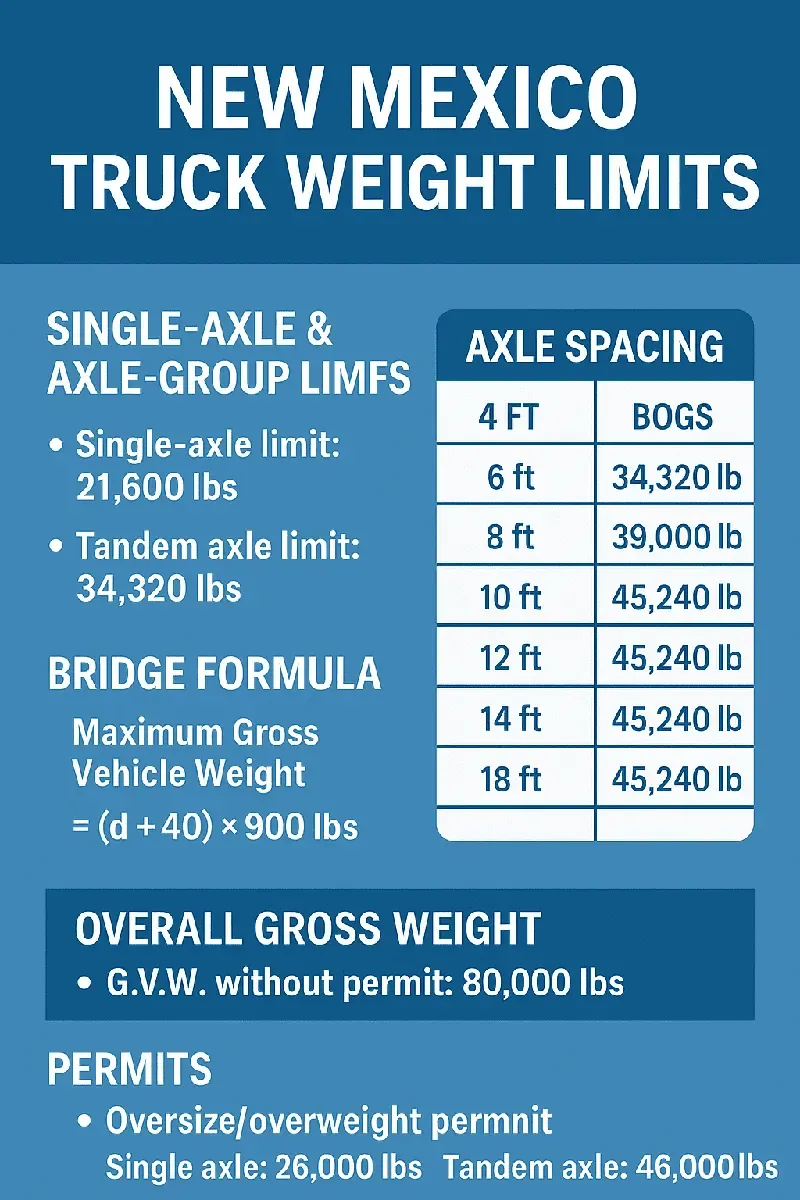
1. Single‐axle & axle‐group limits
Single‐axle limits
-
Under N.M. Stat. § 66‑7‑409, the gross weight imposed by the wheels of any one axle of a vehicle shall not exceed 21,600 pounds.
-
Also in § 66-7-409, any single wheel shall not carry more than 11,000 pounds.
-
For tire width: No wheel equipped with pneumatic/solid/cushion tires may carry a load in excess of 600 lb per inch of tire width.
Tandem axle & groups of axles
-
Tandem axle loads are limited by the group-spacing rules (see next section) but § 66-7-409 says the allowed load on a tandem must not exceed the weight given in § 66-7-410 for the respective distance between the axles.
-
For example, from § 66-7-410: For a group of axles whose first to last axles are 4 ft apart, the allowed load is 34,320 lb. For 5 ft spacing it’s 35,100 lb, etc up to 18 ft = 45,240 lb.
Practical note
-
If you have a truck/trailer combination, you must check each axle group (single, tandem, tridem) and also the total gross weight and the spacing between axles to see which table applies.
-
The tire‐width rule means you should check the actual tire size and load rating, especially when running heavy loads.
-
Some online summaries cite common values: single axle ~20,000-21,600 lbs; tandem ~34,000 lbs.
2. Bridge formula / gross weight by axle spacing
This is often referred to as the “bridge law” or “group of axles” formula—it ties the allowable gross weight to the spacing between the first and last axle in a group.
Statutory table
-
In § 66-7-410 A: For a group of two or more consecutive axles where the distance between first and last axle is 4 ft, allowed gross weight is 34,320 lb; at 10 ft, it’s 39,000 lb; at 18 ft, it’s 45,240 lb.
-
In § 66-7-410 B: For distances over 18 ft, additional table values are provided. For example a 30 ft spaced group allows 63,000 lb, 40 ft spacing allows 72,000 lb, etc.
Formula version
-
According to a policy document by the New Mexico Department of Public Safety (Size & Weight – Vehicle Approach Checks), the formula is:
Maximum Gross Vehicle Weight = (d + 40) × 900
where d = distance in feet between first and last axle of the group. -
This formula provides a quick way to estimate allowable weight for spacing beyond the table.
Why it matters
-
As axle spacing increases (i.e., more axles or wider spread), allowable weight goes up—this helps protect bridges from concentrated loads.
-
If you load a rig with many axles but very close spacing, you may exceed the table/gross‐weight limit despite having many axles.
-
Inspectors will check spacing, axle weights, and the gross weight to ensure compliance under both the “per axle” rules and the bridge‐law rules.
3. Overall gross vehicle weight (GVW)-without special permit
-
Many sources cite the typical legal GVW on state and federal routes in New Mexico without special permits as 80,000 lb.
-
In the Trucker’s Guide, it states the “maximum legal weight for the vehicle or vehicle combination shall not exceed 86,400 lb on Federal Designated routes”.
-
Important: If your combination exceeds statutory tables/spacings, you’ll need an oversize/overweight (OS/OW) permit from the New Mexico Department of Transportation (NMDOT).
4. Oversize/Overweight permits & special routes
-
For loads exceeding standard limits (size or weight), New Mexico issues OS/OW permits.
-
Example values from a permit‐guide: maximum single‐axle permitted ~26,000 lb; tandem ~46,000 lb; tridem ~60,000 lb; overall GVW under permit can be much higher depending on number of axles and routing.
-
Always check route restrictions: certain roads/bridges may have lower posted limits.
5. Key practical tips for compliance
-
Weigh your truck combination: Ensure no single axle or wheel exceeds the 21,600 lb (or wheel limit) rule.
-
Check axle spacing: Measure distance from first to last axle in the group; apply table or formula accordingly.
-
Check gross weight: Ensure your GVW is within the table/bridge‐formula limits for your axle spacing and group.
-
Check local/posted limits: Some bridges or local roads may have lower limits; posted “No trucks over ___ lbs” signs must be obeyed.
-
Permit before moving heavy loads: If you exceed standard limits (axle/single/spacing/GVW), get an OS/OW permit.
-
Document carefully: Especially for oversize/overweight operations, keep routing, permit, weight ticket, axle diagrams, and spacing calculations.
-
Tire width matters: Don’t ignore the rule of 600 lbs per inch of tire width; too narrow tires may reduce allowable load.
-
Natural‐gas/idle‐reduction allowances: Under § 66-7-410 D, vehicles using idle‐reduction tech or natural gas fuel systems may get modest weight allowances.