1. Legal Foundations & Authorities
-
The New Mexico Statutes, Chapter 65, Article 5, Section 65-5-1 mandates that all commercial motor carrier vehicles entering, leaving, or traveling through the state on designated highways must stop at every operating Port of Entry for manifesting and clearance, unless excepted by law.
-
State authorities with inspection powers include the New Mexico State Police – Commercial Vehicle Enforcement (NMSP-CVE) and the Motor Transportation Division.
-
Field enforcement (roadside stops) is allowed when an officer observes violations or has reasonable suspicion, and inspections may be conducted in those settings.
2. Ports of Entry (POE) / Fixed Inspection Stations
-
Ports of Entry are fixed points operated by New Mexico’s Motor Transportation Police / Motor Transportation Division, located on key highways.
-
At POEs, the following inspections / checks are typical:
-
Credential check: driver license, vehicle registration, permits (oversize/overweight), trip permits, IFTA / fuel taxes, etc.
-
Weight & size: Both gross weight and axle weight are checked. Oversize/ overweight loads must have proper state permits.
-
Vehicle inspection: Mechanical condition — brakes, lights, tires, safety equipment. Checking whether the vehicle is road-worthy and safe.
-
Manifest / cargo documentation: Origin, destination, weight of cargo, invoices or bills describing contents; verifying declared cargo weight.
-
-
At border POEs (e.g. Santa Teresa, Columbus), there are also safety inspection facilities for entering trucks; sometimes inspections are in separate facilities near the port.
3. Roadside / Mobile Inspections & Weighing
-
Officers (CVE / MTP) also conduct inspections away from fixed POEs:
-
Roadside safety inspections when violations are observed.
-
Mobile inspection units are used, including surprise roadside inspections in remote or rural areas.
-
-
Weighing:
-
When a vehicle appears overweight (or the inspector suspects so), the officer may require it to stop and be weighed on either portable or stationary scales.
-
If found overweight, the driver must offload or adjust the load to bring gross or axle weight into compliance.
-
4. Inspection Levels & Outcomes
-
Inspections are carried out in levels (as per Commercial Vehicle Safety Alliance CSA / CVSA standards):
-
Level 1: Full inspection (vehicle + driver + credentials + cargo etc.)
-
Level 2 / Level 3 etc.: Varying detail (e.g. walk-around, walk-around + driver inspection or credentials)
-
-
Vehicles / drivers can be placed out of service if serious safety defects or non-compliance are found.
5. Additional / Special Procedures
-
Smart Roadside Inspection System:
-
NM uses a system that scans plates / DOT numbers and pulls up safety history (such as FMCSA / CSA data) to help prioritize which trucks get inspected. This helps focus resources on potentially riskier carriers.
-
-
Border Commercial Zones: Trucks from Mexico (or carriers in those zones) must meet the same safety, driver qualifications, insurance, logbook, and registration requirements as U.S. carriers.
6. What Drivers / Carriers Should Expect (“What Happens”)
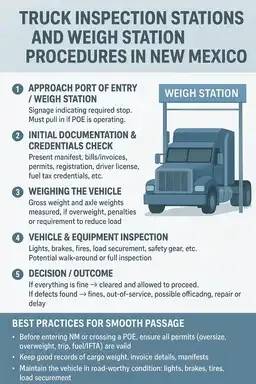
Here’s a rough flow of what a driver/carrier should expect when approaching / undergoing inspection / weigh station in New Mexico:
| Step | What Happens | Things to Have / Check Beforehand |
|---|---|---|
| Approach Port of Entry / Weigh Station | Signage indicating required stop. Must pull in if POE is operating. | Know whether the route includes POEs; ensure you comply with all operational permits, credentials. |
| Initial Documentation & Credentials Check | Present manifest, bills/invoices, permits, registration, driver license, fuel tax credentials, etc. | Keep all documents current, properly filled out. Cargo details correct. |
| Weighing the Vehicle | Gross weight and axle weights measured; if overweight, penalties or requirement to reduce load. | Know your loaded weights, use proper scale before POE if possible. |
| Vehicle & Equipment Inspection | Lights, brakes, tires, load securement, safety gear, etc. Potential walk-around or full inspection. | Keep maintenance up; inspect vehicle before trip. |
| Decision / Outcome | If everything is fine → cleared and allowed to proceed. If defects found → fines, out-of-service, possible offloading, repair or delay. | Plan for downtime; know nearest repair / load‐off locations. |
7. Challenges & Common Issues
-
Overweight violations are common.
-
Mechanical defects: lights, brakes, tires are often cited.
-
Delays at ports of entry when inspections backlog increases or staffing is limited.
-
Issues for carriers unfamiliar with NM’s manifest and permit requirements.
-
Having correct documentation for oversize/overweight permits; route restrictions sometimes apply.
8. Penalties & Consequences
-
A truck may be placed out of service if safety or mechanical defects are serious.
-
Overweight loads may require unloading or payment of fines.
-
Missing or incorrect documentation (manifest, invoices, permits) can lead to delays, citations.
-
Operating without required credentials (IFTA, fuel tax, insurance, permits) can result in fines or denial to cross a POE.
9. Best Practices for Smooth Passage
-
Before entering NM or crossing a POE, ensure all permits (oversize, overweight, trip, fuel/IFTA) are valid.
-
Keep good records of cargo weight, invoice details, manifests.
-
Maintain the vehicle in road-worthy condition: lights, brakes, tires, load securement.
-
Use tools / apps or contact local authorities to verify weigh station and port of entry hours. (POE operating hours vary).
-
Be ready for inspections in border commercial zones if applicable.