Key Trends
-
Increasing Freight & Trade Volume
-
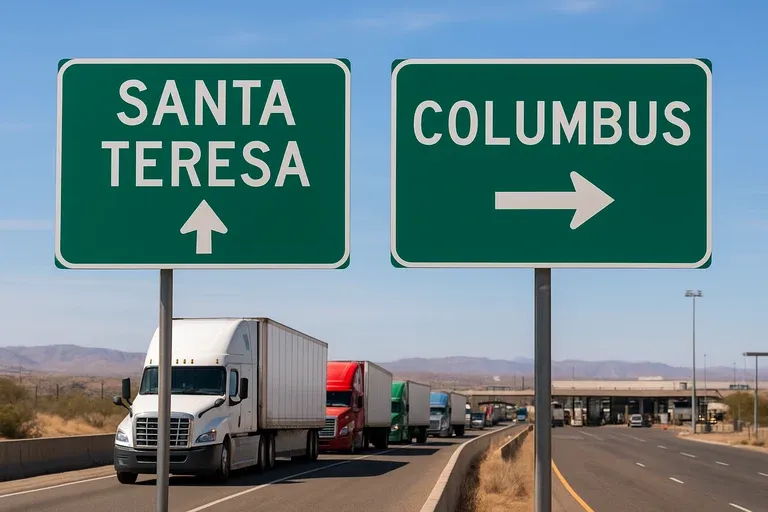
Freight volumes through Santa Teresa have been rising, especially as U.S.–Mexico trade intensifies. For example, import volume from Mexico is up ~33% month-over-month in some datasets, boosting outbound truckload volumes significantly.
-
Columbus has seen rising traffic too, particularly agricultural imports (e.g. chile) during harvest seasons.
-
-
Santa Teresa as a Relief Route / Alternative Crossing
-
Because some Texas ports (especially around El Paso) suffer long wait times, inspections, or congestion, Santa Teresa is increasingly used as a bypass for traffic.
-
There are efforts to extend hours, open additional lanes (including weekend or Saturday commercial lanes), to accommodate this diverted traffic.
-
-
Infrastructure Expansion & Modernization Efforts
-
Both Santa Teresa and Columbus are undertaking (or planning) upgrades to handle higher capacity. For Columbus, this includes efforts to improve drainage (flooding problems), better inspection facilities, expanded size to handle more traffic.
-
The “Borderplex” area is seeing investment: roads serving Santa Teresa are under strain; planned developments include large housing, industrial parks, etc., anticipating growth in freight/logistics usage.
-
-
Regulatory and Operational Adjustments
-
Because of border policy changes (e.g. enhanced inspections), there has been more unpredictability in wait times and scheduling. Santa Teresa has responded by expanding hours of operation.
-
Agriculture inspections are more active at Columbus for crop imports (e.g., chile), with more specialists assigned during peak seasons.
-
-
Trade Value Growth & Strategic Importance
-
NM Ports of Entry have seen trade value increase significantly (over 26% in certain measurements) since ~2023.
-
Santa Teresa in particular is being promoted as a “strategic reliever route” to ease pressure on other Southwest border crossings.
-
Main Challenges
-
Insufficient Infrastructure / Capacity Bottlenecks
-
Lane capacity: Santa Teresa has limited commercial truck lanes (only three) which constrains throughput relative to demand.
-
Port layout issues: The port was not designed for some of the large or heavy loads now coming through (e.g. oversized turbine blades), leading to difficulties in maneuvering.
-
Lack of certain designations: For example, Santa Teresa is not certified as a hazardous materials (hazmat) port. That blocks certain cargo, even relatively innocuous ones (like soft-drink syrup). This has led to lost business.
-
-
Flooding & Environmental Constraints
-
Columbus has had flooding issues, especially during heavy rain events, which can damage structure or impede access. Infrastructure works must address drainage.
-
Santa Teresa’s surrounding road network experiences wear and tear: industrial roads and connections are degraded due to heavy frequent truck traffic.
-
-
Regulatory Constraints & Operational Limits
-
Hours of operation sometimes don’t match demand (though some extended hours additions are underway). Delays in processing (inspections, customs) especially for agricultural goods or hazardous materials.
-
The lack of hazmat designation at Santa Teresa means rerouting or rejection of certain shipments.
-
-
Workforce & Support Services Gaps
-
Housing for the workforce near Santa Teresa is lacking; many workers commute long distances from El Paso or Las Cruces. This adds constraints on labor availability.
-
Supporting services (inspection, customs/agriculture specialists) need to scale up during peak import seasons; surges overwhelm capacity.
-
-
Freight Waiting / Delay Issues
-
Due to inspection bottlenecks, wait times can increase, especially if Ports of Entry elsewhere are congested or undergoing enhanced inspections. Some of this delay is due to international border policy changes.
-
Delays to livestock trade: the Santa Teresa livestock (cattle/horse/bison) crossing is closed currently (or as of mid-2025) because of animal health issues like the New World screwworm. This disrupts that segment of freight.
-
-
Missed Opportunities / Business Loss
-
Because of infrastructure or regulatory limitations, some companies have avoided setting up operations or routing freight through Santa Teresa. The hazmat limitation is one example.
-
Oversized or unusual shipments (blades, large parts) are harder to move because of port geometry, low clearances, or tight turns.
-
Implications & Recommendations
Here are some implications of these trends/challenges, and potential policy or business strategies:
| Implication | Possible Responses / Strategies |
|---|---|
| Rising freight demand may outstrip capacity | Invest in physical expansion: more lanes, wider inspection bays, improved road access into ports. |
| Traffic diversion will increase load on Santa Teresa | Plan for upgraded infrastructure, staffing, and equipment to handle higher cross-border volumes. |
| Regulatory limits (hazmat, livestock) exclude certain shipments | Seek certifications/designations where possible; invest in safety/special handling facilities. |
| Flooding and environmental constraints threaten operations | Improve drainage, use climate-resilient design in expansions; site drainage improvements, better road surfaces. |
| Workforce shortages, commuting burdens | Develop housing near industrial/logistics hubs; incentivize local workforce training. |
| Wait times & processing delays erode competitiveness | Extend hours, streamline inspection processes, add automation/technology (e.g., for customs, agriculture screening). |