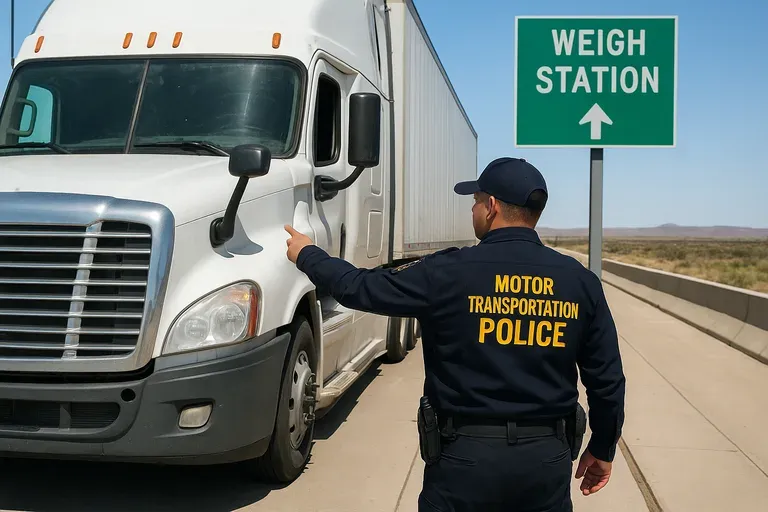
1. Enforcement of Trucking Regulations
The MTPD enforces both state and federal commercial vehicle laws, including:
-
Weight and size limits for trucks and trailers.
-
Hours-of-Service (HOS) compliance to prevent driver fatigue.
-
Hazardous materials (HAZMAT) transportation regulations.
-
Commercial Driver’s License (CDL) requirements and drug/alcohol testing compliance.
Officers conduct roadside inspections and audits in coordination with the Federal Motor Carrier Safety Administration (FMCSA) to ensure operators meet national standards.
2. Weigh Station Operations
New Mexico’s MTPD manages permanent and mobile weigh stations across the state.
These facilities check for:
-
Overweight or overloaded vehicles.
-
Proper registration and permits for oversize loads.
-
Accurate logbooks and electronic logging device (ELD) data.
By enforcing weight restrictions, the MTPD helps protect highway infrastructure from damage and reduces accident risks caused by improperly loaded trucks.
3. Safety and Compliance Inspections
MTPD officers perform Level I through Level VI inspections, which can include checking:
-
Brake systems
-
Tires and lighting
-
Driver records
-
Cargo securement
-
Vehicle registration and insurance
The division’s proactive inspection program aims to reduce crashes involving commercial motor vehicles (CMVs) and maintain public safety on major freight routes.
4. Oversize/Overweight Permits and Routing
The MTPD collaborates with the New Mexico Department of Transportation (NMDOT) to issue and monitor oversize and overweight permits.
They ensure trucks carrying large loads—such as oilfield equipment or wind turbine components—follow approved routes, avoiding unsafe bridges or environmentally sensitive areas.
5. Cross-Border and Interstate Coordination
Given New Mexico’s proximity to Texas, Arizona, Colorado, and Mexico, the MTPD works closely with neighboring states and U.S. Customs and Border Protection to:
-
Monitor commercial traffic at border crossings (e.g., Santa Teresa Port of Entry).
-
Prevent illegal smuggling, human trafficking, and drug transport through freight vehicles.
-
Facilitate safe, efficient trade across state and national borders.
6. Education and Industry Outreach
Beyond enforcement, the MTPD also emphasizes education and partnership with the trucking community.
They conduct training sessions and outreach programs to help fleet operators understand:
-
New compliance requirements
-
Road safety practices
-
Best methods for emissions and fuel efficiency
This cooperative approach improves compliance rates and strengthens trust between law enforcement and trucking businesses.
7. Contribution to Public Safety and the Economy
Through its regulatory oversight, the MTPD not only reduces the number of commercial vehicle-related crashes but also ensures fair competition among carriers.
By enforcing consistent standards, the division helps maintain an even playing field—benefiting both large logistics companies and small independent operators across New Mexico.
In Summary
The Motor Transportation Police Division serves as the backbone of New Mexico’s commercial vehicle safety and enforcement system. Balancing regulation with education, the MTPD ensures that trucking operations remain safe, efficient, and compliant, supporting the state’s economic growth while protecting motorists and infrastructure.