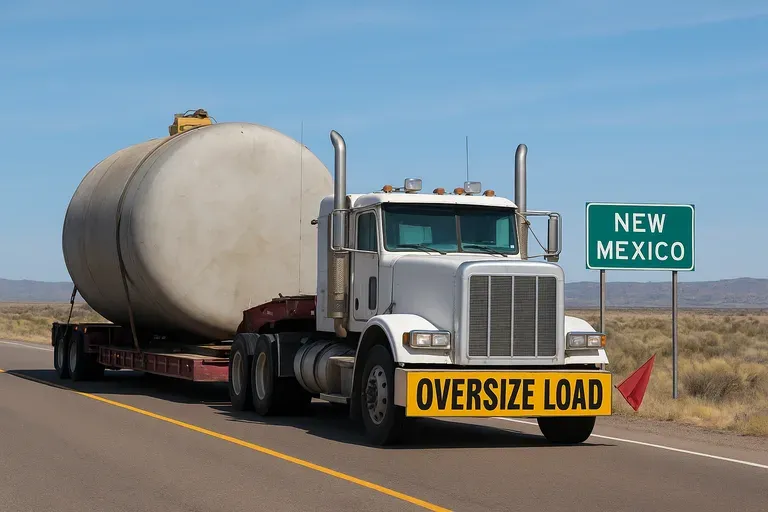
What triggers an OS/OW permit
In New Mexico, you must obtain a special permit before moving a vehicle or load that exceeds standard size or weight limits. Key points:
-
A permit is required for a vehicle, combination or load entering New Mexico if it is oversize or overweight.
-
Oversize is triggered when dimensions exceed set maxima (for width, height, length) and overweight when gross weight or axle/tandem weight limits are exceeded.
-
A permit may allow travel on highways under jurisdiction of the state transportation commission or local authorities.
What the statutory law says
Here are relevant statute highlights from New Mexico Statutes Section 66‑7‑413 (NMSA) and related sections:
-
The statute authorizes the DOT or local highway authorities, in their discretion, to issue a special permit for operation of a vehicle or load exceeding the maximum size/weight in Sections 66-7-401 to 66-7-416
-
Permits may be for a single trip or (in emergency cases) up to one year.
-
The permit must specify the route to be traversed, the type of load, and any restrictions deemed necessary.
-
Insurance and registration requirements: A motor carrier requesting an OS/OW permit must provide proof of minimum insurance coverage: bodily injury ($50,000 per person / $100,000 per accident) and property damage ($25,000 per accident).
-
Special rule: For vehicles with gross weight not exceeding 96,000 lbs within six miles of the Mexico border port of entry at Santa Teresa (and certain quadrant), the applicant is not required to demonstrate the load cannot be reduced (i.e., “non-divisible” test) as a condition of permit issuance.
Administrative & regulatory requirements
Beyond the statute, there are administrative rules and procedures enacted by NMDOT / New Mexico Administrative Code (NMAC). Key items:
-
Under rule 18.19.8 NMAC, an oversize or overweight vehicle, combination or load must have a special permit issued before entry into New Mexico.
-
If an escort vehicle is required, it must be certified by DOT or DPS before entry. If it's not certified, the escort vehicle and load must stop outside the state until certification is obtained.
-
Before commencing the move, permittee must review the permit for accuracy, ensure any route survey/maps are included, understand all conditions, know the route.
Permit types & fees
Here are some of the key types of permits and their typical fees:
-
Single-trip permit: For a one-time special move of oversize/overweight vehicle or load. For example: A single trip overweight permit fee is 925 plus an additional fee calculated at $.055 for each 2,000 lbs (or major fraction thereof) over 86,400 lbs multiplied by the number of miles to be traveled.
-
Annual / multiple‐trip permit: For repeated moves (within terms) a carrier may get a permit valid for up to a year. For some loads, the upper gross weight allowed is up to 140,000 lbs.
-
Escort fees: If a State Police escort is required, additional fees apply (e.g., $300 per day in one fee schedule).
Key dimension/weight triggers & conditions
Here are some specific numeric limits and conditions to watch:
-
One checklist says: any vehicle or load exceeding 8 ft 6 in width, 14 ft height, 65 ft overall length, or 80,000 lbs gross weight will trigger the need for an OS/OW permit.
-
Some permit programs allow up to 140,000 lbs gross vehicle weight (GVW) under the annual permit scheme (for some specialized loads) without needing engineering review. Vehicles over 170,000 lbs would require a special engineering review.
-
For axle/tandem loads: Under section 66-7-413.8 (Multiple-trip permit for specialized haul vehicles) a permit may be issued if, for example, the vehicle has 4-7 axles with distance between first and last axle 20-36 ft, the weight on each axle and tandem does not exceed certain specified limits.
Route, escort, and operational restrictions
When you move an oversize/overweight load, there are additional operational factors:
-
The permit will specify the route to be traversed — you must stay on the authorized route. Statute requires it.
-
Escort vehicle requirement: If required, the escort must meet certification, and if entering New Mexico with an escort, the escort must be certified before entering. If not, must stop and fix.
-
Conditions may include restrictions on days/times of operation, weather conditions, speed, etc. (The statute authorizes the DOT to promulgate rules concerning time periods of movement).
-
The load must be non-divisible in many cases: That is, it cannot be reasonably dismantled or reduced to become a legal load under standard limits. For example, one guide states "LOADS MUST BE IRREDUCIBLE – A permit will not be issued for reducible non-liquid loads that can be shifted or unloaded…"
Steps to apply
Here’s a simplified step-by-step process for applying in New Mexico:
-
Determine whether your vehicle/load exceeds standard limits (width, height, length, weight, axle/tandem).
-
Determine if the load is reducible or non-divisible (for weight permits).
-
Gather required documentation: applicant info, vehicle registration, proof of insurance (minimums as statute states).
-
Submit a permit application ( online through ePermitting system www.newmexicotruckingonline.com ) before the load enters the state.
-
Pay the applicable fee (single-trip or annual) based on weight, miles, etc.
-
Receive permit which will specify: route, conditions/restrictions, any required escorts.
-
Before commencement of the move, review permit, ensure all conditions (route survey, maps) are included.
-
Move only on authorized route and comply with all conditions (escort, signage, flags, lights).
-
If stopped at a weigh station or checkpoint, have the permit available for inspection (statute requires the permit be carried in the vehicle).
Practical tips & things to watch
-
If you’re entering New Mexico from another state, consider whether you need to obtain the permit before entry. Rule 18.19.8.20 says you must have a permit before entry.
-
Check whether your route passes through any bridges or structures that might limit height/weight — even with a permit, route is restricted.
-
If your load is oversized (width/height/length) you’ll likely need the proper signage (“OVERSIZE LOAD” banner), flags, lighting as required by state rules. One guidance note says New Mexico requires front and rear “OVERSIZE” signs if load exceeds certain width.
-
Keep a copy of the permit accessible in the vehicle at all times. A permit violation can lead to the load being detained until corrected.
-
Make sure your insurance and carrier credentials meet the minimums required by statute.
-
If your weight is within certain special zones (e.g., near the Mexico border within six miles of the port of entry at Santa Teresa) and under certain weights (96,000 lbs) the requirement to show load non-divisibility may be waived.
-
Be aware of enforcement at ports of entry — as the NMDOT Ports of Entry Information indicates, commercial vehicles must stop, and oversize/overweight loads are regulated.