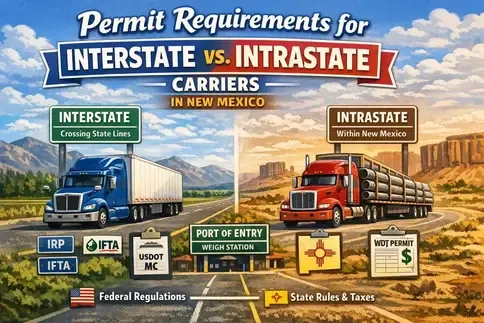
Key Regulatory & Permit Requirements
1. Registration and Authority
Interstate Carriers:
-
Must register under the federal International Registration Plan (IRP) if operating across state lines — apportioned plates are issued so fees are shared among jurisdictions.
-
Must also get a U.S. DOT Number and, often, an MC Number from FMCSA if transporting freight for hire.
-
May need a Unified Carrier Registration (UCR) based on fleet size.
-
Often need an International Fuel Tax Agreement (IFTA) license for fuel reporting in multiple states.
Intrastate Carriers:
-
Must register with the New Mexico Public Regulation Commission (PRC) to get authority to operate within the state.
-
PRC issues a “warrant” certificate or a specific intrastate authority depending on carrier type.
-
-
Do not need IRP plates or IFTA if they stay entirely within New Mexico.
2. Weight-Distance Permits & Tax
Both interstate and intrastate commercial motor vehicles with a declared gross weight over 26,000 pounds must obtain a New Mexico Weight-Distance Permit and pay associated tax.
-
This permit is tied to the weight-distance tax, which must be filed quarterly based on miles traveled in the state.
-
Weight-Distance Permits apply regardless of whether trips are only intrastate or part of interstate routes.
3. Oversize/Overweight Permits
Both types of carriers must obtain oversize/overweight permits from the New Mexico Motor Transportation Police or at ports of entry whenever loads exceed state size and weight limits.
Key points:
-
Permits are required before transporting loads exceeding size or weight limits set in state law.
-
Permits may be single-trip, multiple county, or statewide (annual) depending on needs.
-
All vehicles may be stopped at ports of entry for compliance checks, regardless of interstate or intrastate status.
4. Compliance & Enforcement
Intrastate Carriers:
-
Must comply with New Mexico vehicle safety, insurance, and permit requirements.
-
Insurance proof (minimum liability) is required for oversize/overweight permits.
Interstate Carriers:
-
Must meet all intrastate obligations plus federal FMCSA standards (such as hours-of-service, vehicle inspections, driver qualifications, and more).
Practical Differences Summarized
| Requirement | Intrastate | Interstate |
|---|---|---|
| IRP Registration | Not required | Required |
| IFTA License | Not required | Required |
| WDT Permit & Tax | Yes | Yes |
| Oversize/Overweight Permits | Yes | Yes |
| FMCSA Authority | Not required for purely intrastate | Required |
| Port of Entry Stops | Yes | Yes |
In Simple Terms
-
Intrastate carriers need state permits and PRC authority but not federal interstate registrations.
-
Interstate carriers need both state permits and applicable federal registrations (IRP, IFTA, DOT/MC numbers, UCR, etc.).
-
All carriers hauling heavy or oversize loads must get proper permits and pay the weight-distance tax.
https://www.mvd.newmexico.gov/commercial/resources-and-information/