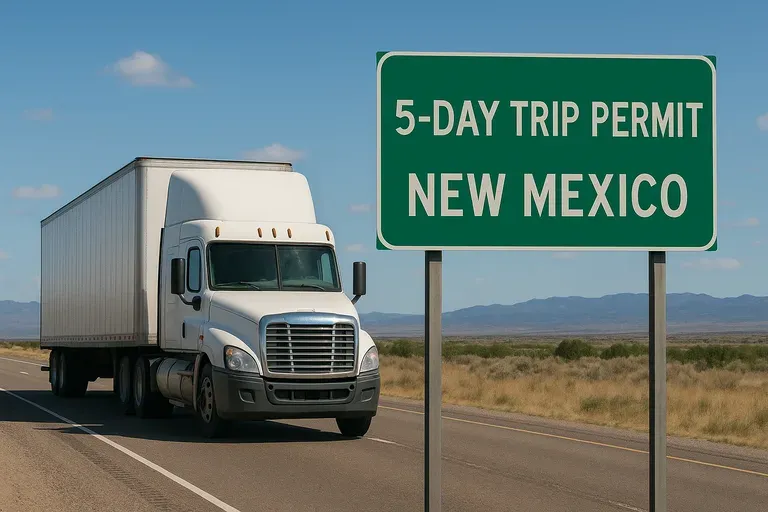
1. What Is a Trip Permit in NM?
-
In New Mexico, a “trip permit” (often tied to the trip tax) applies to certain commercial vehicles that are not registered permanently in the state.
-
It’s essentially a way for out-of-state trucks or carriers to pay for highway use without full NM vehicle registration.
-
The trip permit is issued by the Motor Transportation Police Division (MTPD), typically at a port of entry.
-
Revenue from the trip tax funds New Mexico’s road fund.
2. When You Need a Trip Permit
You generally need a trip permit when:
-
Your vehicle is not registered in New Mexico, or not apportioned under IRP.
-
You're operating a commercial vehicle (“for hire”) that will be doing business (or passing through) in NM.
-
Your gross vehicle weight (GVW) is above certain thresholds. For example, some sources say trip tax kicks in for heavier vehicles.
-
You don’t have a Weight-Distance (WD) account in NM.
But: If your vehicle is registered under IRP (International Registration Plan), you do not need a trip permit.
Also, carriers enrolled in NM’s Weight-Distance tax program may also avoid needing a trip permit.
3. Validity (How Long the Permit Lasts)
-
According to a trucking-permit service, the NM trip permit is valid for 5 consecutive days from the time of issuance.
-
This aligns with the idea of a “trip” permit rather than long-term registration.
-
Note: This “5-day” duration comes from third-party permit vendors; always check with official state authorities or MTPD for current terms.
4. Cost / Tax Calculation
-
The trip tax in New Mexico is based on vehicle weight and miles traveled in NM.
-
From the New Mexico Trucker’s Guide:
GVW (Gross Vehicle Weight) Trip Tax (per mile) 12,001 – 26,000 lbs $0.57 / mile 26,001 – 54,000 lbs $0.72 / mile 54,001 – 72,000 lbs $0.95 / mile Over 72,000 lbs $1.04/ mile -
For oversize/overweight loads, there are special permits:
-
A single-trip overweight or oversize permit costs $95.
-
For extreme weights (over 86,400 lbs), there's an extra fee: $0.25 per ton-mile (for the miles in NM) for the excess weight.
-
-
Note: Some older documents mention a $75 single-trip permit, but that may be outdated or context-specific.
-
There may also be police escort fees if escort vehicles are required.
5. Rules & Requirements
-
For oversize/overweight loads:
-
A special permit is needed before entry into NM if your load exceeds legal size/weight.
-
The permit must specify the route, the load type, and any special restrictions.
-
If an escort vehicle is needed, it must be certified by NM DOT or DPS; otherwise, the load may have to stop outside the state until proper certification is obtained.
-
-
Insurance Requirements: For special permits, carriers must provide proof of liability insurance:
-
Bodily injury: at least $50,000 per person / $100,000 per accident
-
Property damage: at least $25,000 per accident
-
-
Permit must be carried in the vehicle at all times and made available for inspection by law enforcement.
-
Carrier must obey any “conditions or terms” specified in the permit; violation could be a misdemeanor.
6. How to Apply
-
Use the www.newmexicotruckingonline.com or Phone (505) 578-2195
-
For special (oversize/overweight) permits, you might need to submit additional documentation (route survey, load specs, insurance, etc.).
7. Risks, Penalties & Enforcement
-
Operating a vehicle in NM without the proper trip permit or special permit (when required) can lead to citations, fines, or being halted.
-
If you violate the terms of a special permit (e.g., deviate from route or exceed weight), the permit can be revoked.
-
For oversize loads, failing to have the right escort or not meeting permit conditions can result in serious enforcement.
8. Pros & Considerations for Carriers
Pros:
-
Trip permits let out-of-state carriers avoid full NM registration, saving time/cost (if it's just transiting or doing limited business).
-
Flexible: 3-day (72-hour) coverage is often enough for many operations.
-
Online permit systems make it easier to apply ahead of time.
Considerations:
-
Trip tax can add up if you’re carrying a heavy load over many miles — calculate carefully.
-
If you repeatedly operate in NM, it may be more economical to get a WD (Weight-Distance) permit or open an account instead of buying trip permits for every trip.
-
Oversize / overweight loads pose additional paperwork, cost, and risk (inspections, route restrictions, escort).
-
Maintain proper documentation (permit, insurance proof, load plan) to avoid stops and fines.