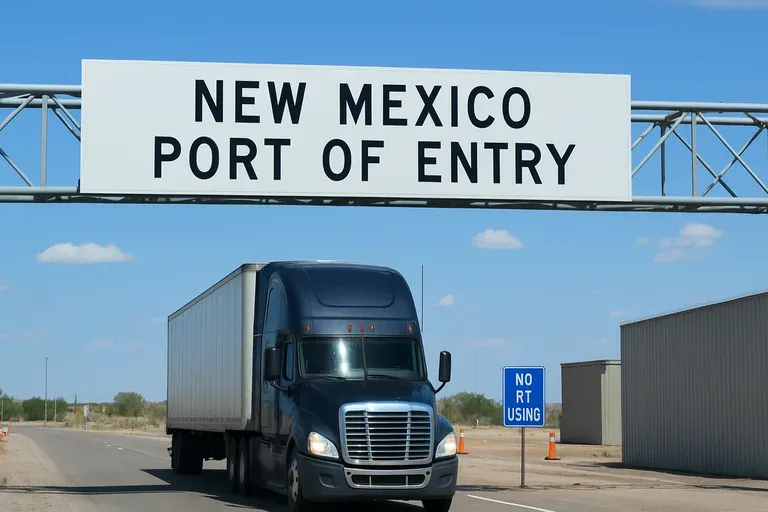
1. What Is a New Mexico Port of Entry?
A New Mexico POE is a state-controlled checkpoint operated by:
-
New Mexico Motor Transportation Police (MTPD)
-
New Mexico Department of Transportation (NMDOT)
-
New Mexico Taxation & Revenue Department (NMTRD) (for WDT compliance)
Every commercial vehicle entering New Mexico must stop at the first open POE unless exempted by signage or electronic bypass systems.
2. What Happens at a New Mexico POE?
Here are the typical steps a driver will go through:
Step 1 — Mandatory Stop
All commercial vehicles (including light duty trucks if for business) must pull in unless they have a certified bypass signal.
Step 2 — Weight and Credential Check
Agents review:
-
Registration
-
IFTA credentials
-
IRP cab card
-
USDOT/MC numbers
-
New Mexico Weight Distance Tax permit (WDT)
-
OS/OW permits if applicable
-
Insurance compliance
Step 3 — Scale Weigh-In
Vehicles are weighed to verify:
-
Axle weight
-
Gross weight
-
Distance-based weight compliance
-
Whether the load requires a trip or annual OS/OW permit
Step 4 — Safety Inspection (as required)
Officers may conduct:
-
Level 3 paperwork inspections
-
Lights, brakes, tires, and securement checks
-
Driver qualification checks
-
Hours-of-service verification
Step 5 — Clearance or Enforcement
If everything is compliant, the driver is released.
If not, the POE may issue:
-
Fines
-
Out-of-service orders
-
Requirements to purchase missing permits on the spot
-
Route changes for OS/OW vehicles
3. Common Issues at New Mexico POEs
New Mexico’s ports are known for strict enforcement. These are the problems carriers most frequently encounter:
1. Missing or Invalid Weight Distance Tax (WDT) Permit
New Mexico requires all commercial vehicles over 26,000 lbs to register for WDT.
Common violations:
-
Carrier never registered for WDT
-
Expired WDT account
-
Missing WDT cab card in the vehicle
-
WDT number not properly linked to the USDOT
2. Improper or Missing OS/OW Permits
New Mexico enforces permit compliance aggressively.
Frequent problems include:
-
Using the wrong route
-
Incorrect axle spacing on permit
-
Overheight/overweight without a permit
-
Self-issued permits used beyond allowable limits
-
Superload requirements not met
3. Logbook and HOS Issues
At POEs, inspectors often look for:
-
Out-of-date ELD entries
-
Drivers in violation of drive-time limits
-
Incorrect duty status
-
Unassigned drive time not accepted by driver
4. Inaccurate or Mismatched Credentials
Officers regularly check for mismatches between:
-
Truck plate
-
VIN
-
IRP cab card
-
IFTA decals
-
Carrier name on the door
Any mismatch can trigger extended inspections.
5. Weight Violations
Even slight axle weight overages result in enforcement.
Frequent causes:
-
Shifting loads
-
Incorrect fifth-wheel positioning
-
Poor load distribution
-
Driver unaware of NM weight rules (one of the strictest in the Southwest)
6. Insurance Problems
Carriers are often held because:
-
Insurance documentation is missing
-
Policy numbers don’t match the unit
-
Insurance is expired in FMCSA’s system
-
Driver cannot present proof when asked
7. Failure to Stop at POE
In New Mexico, bypassing a required POE stop can result in:
-
Immediate pursuit
-
Heavy fines
-
Mandatory full inspection
-
Possible impound or out-of-service order
4. Tips for Smooth New Mexico POE Crossings
-
Make sure the WDT permit is current and in the truck.
-
Keep all permits in a single binder or folder for quick presentation.
-
Scale the truck before entering the state to avoid surprises.
-
Check your OS/OW permit routing carefully—NM is strict on route adherence.
-
Make sure insurance, IRP, and IFTA data matches exactly across all documents.
-
Use PrePass if equipped, but be prepared to enter the POE if instructed.
-
Train drivers to always stop when required—New Mexico enforces this aggressively.
Conclusion
New Mexico Ports of Entry keep close watch on safety, credentials, weight limits, and tax compliance. Carriers who enter unprepared often face delays, citations, and costly enforcement actions.
By understanding NM’s POE procedures—and avoiding the common issues outlined above—drivers and carriers can move through the state efficiently and without interruption.