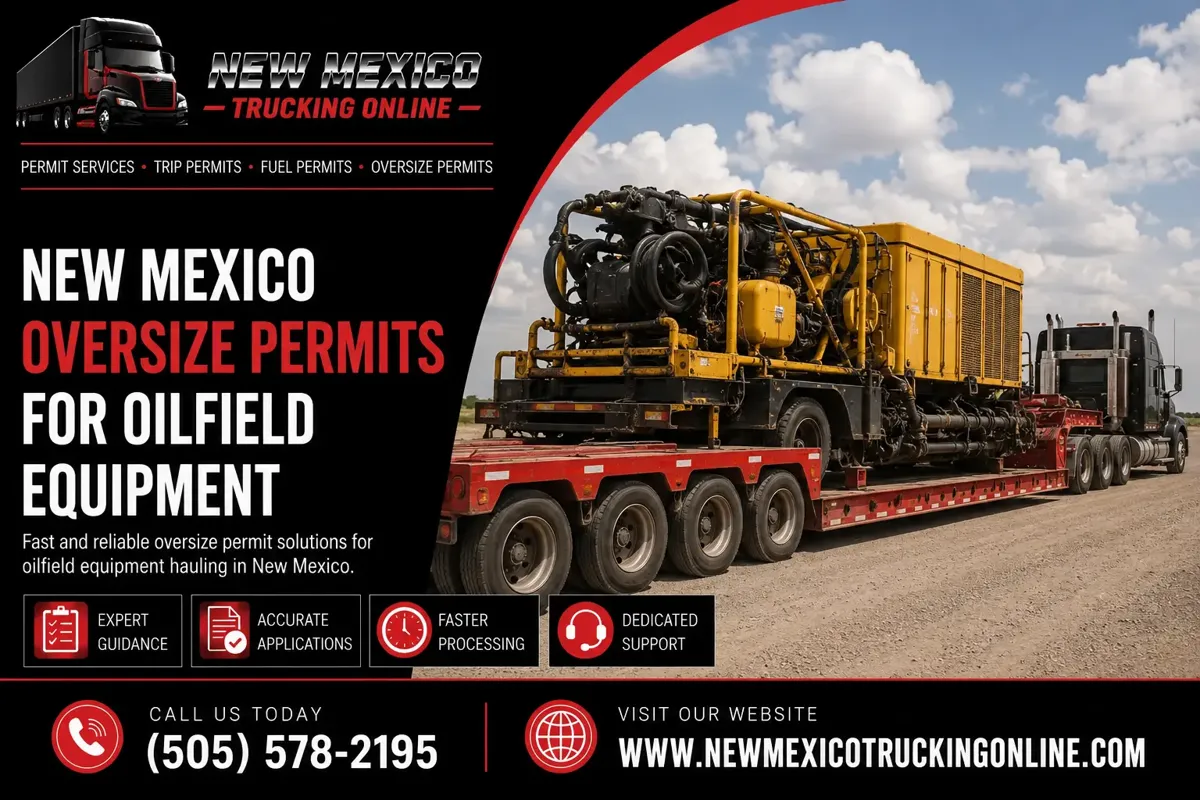
New Mexico Oversize Permits For Oilfield Equipment
Table of Contents
-
Introduction
-
Why Oilfield Equipment Often Requires An Oversize Permit
-
Common Oilfield Equipment Transported In New Mexico
-
New Mexico Oversize Permit Requirements For Oilfield Equipment
-
Information Needed Before Applying
-
Route Planning For Oilfield Equipment
-
Escort And Travel Requirements
-
Common Mistakes To Avoid
-
Why Many Trucking Companies Choose Our Service
-
FAQ
Introduction
New Mexico's oil and gas industry depends on the regular movement of large machinery and specialized equipment between drilling sites, production facilities, yards, and other locations. Many of these loads can exceed standard legal dimensions or weight limits, making an oversize or overweight permit necessary before the equipment moves on New Mexico highways.
Understanding the permitting requirements before the equipment is loaded can help trucking companies avoid delays, incorrect applications, and compliance problems during transportation.
Why Oilfield Equipment Often Requires An Oversize Permit
Oilfield equipment is frequently large, heavy, or difficult to separate into smaller components. Equipment that exceeds New Mexico's legal size or weight limits may require an oversize, overweight, or combined permit before transportation.
Oversize permitting is particularly important for non-divisible equipment that cannot reasonably be reduced to legal dimensions. The specific permit requirements depend on the equipment, vehicle configuration, dimensions, weight, and route.
For oilfield carriers, determining the exact loaded dimensions and weight before applying is an important first step.
Common Oilfield Equipment Transported In New Mexico
Oilfield operations can involve many types of specialized equipment. Common examples include:
-
Drilling rigs and rig components
-
Frac tanks
-
Mud pumps
-
Compressors
-
Coiled tubing units
-
Crane trucks
-
Large tanks and modular units
-
Production equipment
-
Heavy machinery
Some equipment may remain within legal dimensions, while other equipment may exceed width, height, length, or weight limits. The applicable permit requirements depend on the actual loaded configuration.
New Mexico Oversize Permit Requirements For Oilfield Equipment
Before moving oversized oilfield equipment, trucking companies should determine which legal size or weight limits will be exceeded.
A permit may be necessary when the vehicle or load exceeds applicable New Mexico limits for dimensions, gross weight, axle weight, or other regulated conditions. The type of permit required can depend on the size and weight of the movement and whether the equipment is being transported on a single trip or a recurring basis.
For a one-time equipment move, a single-trip permit may be appropriate. Companies that regularly transport similar qualifying equipment may have multiple-trip or annual permit options available depending on the specific operation.
Extremely large or heavy oilfield equipment may require additional review and specialized route planning before the movement can be authorized.
Information Needed Before Applying
Accurate information is essential when applying for an oversize permit for oilfield equipment.
Trucking companies should be prepared to provide information such as the following:
-
Truck and trailer information
-
Axle configuration and spacing
-
Gross vehicle weight
-
Axle weights
-
Overall loaded width
-
Overall loaded height
-
Overall loaded length
-
Description of the oilfield equipment
-
Origin and destination
-
Requested travel route
-
Travel dates
The equipment should be measured based on how it will actually be positioned and transported. Using estimated dimensions or incomplete vehicle information can lead to delays or problems with the permit application.
Route Planning For Oilfield Equipment
Route planning is especially important for large oilfield equipment because the approved route must accommodate the complete vehicle and load configuration.
Carriers should consider bridge restrictions, roadway dimensions, construction areas, clearance limitations, and other restrictions that could affect the movement. A route that works for a standard tractor-trailer may not be suitable for a tall, wide, or unusually long oilfield load.
Planning the route before applying can help identify potential problems and give carriers a better understanding of the requirements that may apply to the movement.
Oilfield operations can also involve remote locations, access roads, and frequent movements between different facilities. Carriers should make sure the planned route can accommodate the entire combination from pickup through delivery.
Escort And Travel Requirements
Depending on the dimensions of the equipment and the approved route, an oversize movement may require pilot cars or other special travel conditions.
The permit may specify requirements relating to escorts, travel times, routes, signage, and other operating conditions. Carriers should review the issued permit carefully and make sure the driver and escort personnel understand the applicable requirements before departure.
Large oilfield loads can also create additional challenges at intersections, narrow roadways, and areas with limited clearance. Proper route planning and compliance with permit conditions are important throughout the entire movement.
Common Mistakes To Avoid
Several mistakes can make an oilfield equipment move more difficult than necessary.
Using estimated dimensions: Oversize permit applications should be based on accurate loaded measurements.
Forgetting axle information: Axle weights and spacing can affect permitting and route evaluation.
Waiting until the equipment is ready to move: Permit planning should begin before the scheduled transportation date.
Assuming every oilfield load needs the same permit: Requirements depend on the specific vehicle, equipment, dimensions, weight, and route.
Ignoring permit conditions: Once issued, the carrier must follow the conditions and route specified for the movement.
Failing to plan for route restrictions: Large equipment may encounter clearance, bridge, construction, or other roadway restrictions that do not affect ordinary commercial vehicles.
Not confirming the final loaded configuration: Changes to the trailer, equipment position, or load dimensions can affect the information provided on the permit.
Why Many Trucking Companies Choose Our Service
Many trucking companies choose New Mexico Trucking Online because the permitting process can be easier when experienced permit specialists handle the details. Our service provides fast processing, 24/7 customer support, weekend and holiday availability, a secure online application process, competitive pricing, and experienced permit specialists who understand New Mexico permitting requirements.
Whether you are transporting drilling equipment, tanks, compressors, rig components, or other specialized oilfield equipment, having accurate information prepared before the movement can make the permitting process much smoother.
Apply online today for your New Mexico oversize permit.
FAQ
Does oilfield equipment always require an oversize permit in New Mexico?
No. The requirement depends on the actual dimensions, weight, vehicle configuration, and applicable legal limits. Equipment that exceeds those limits may require an oversize or overweight permit.
What oilfield equipment commonly requires an oversize permit?
Large drilling equipment, frac tanks, compressors, mud pumps, crane trucks, rig components, and other specialized machinery may require permitting when they exceed applicable legal limits.
What information do I need to apply for an oilfield equipment permit?
You should have accurate vehicle and trailer information, axle configuration, weights, loaded dimensions, equipment description, origin, destination, route, and travel dates available before applying.
Can oilfield equipment qualify for a multiple-trip permit?
Some recurring oilfield equipment movements may qualify for multiple-trip or annual permitting, depending on the applicable permit program and the specific dimensions, weight, equipment, and operating conditions.
Can an oilfield load require both oversize and overweight permitting?
Yes. If the equipment exceeds applicable size and weight limits, the movement may require authorization covering both dimensions and weight.
Are escorts required for oilfield equipment?
Escort requirements depend on the dimensions, route, and conditions of the permitted movement. When escorts are required, carriers must follow the requirements specified for the movement.
Do I need a permit before entering New Mexico with oversized oilfield equipment?
Yes. When an oilfield vehicle or load exceeds applicable legal limits and requires special permitting, the appropriate permit should be obtained before the movement begins.
For more information, visit the New Mexico Department of Transportation.