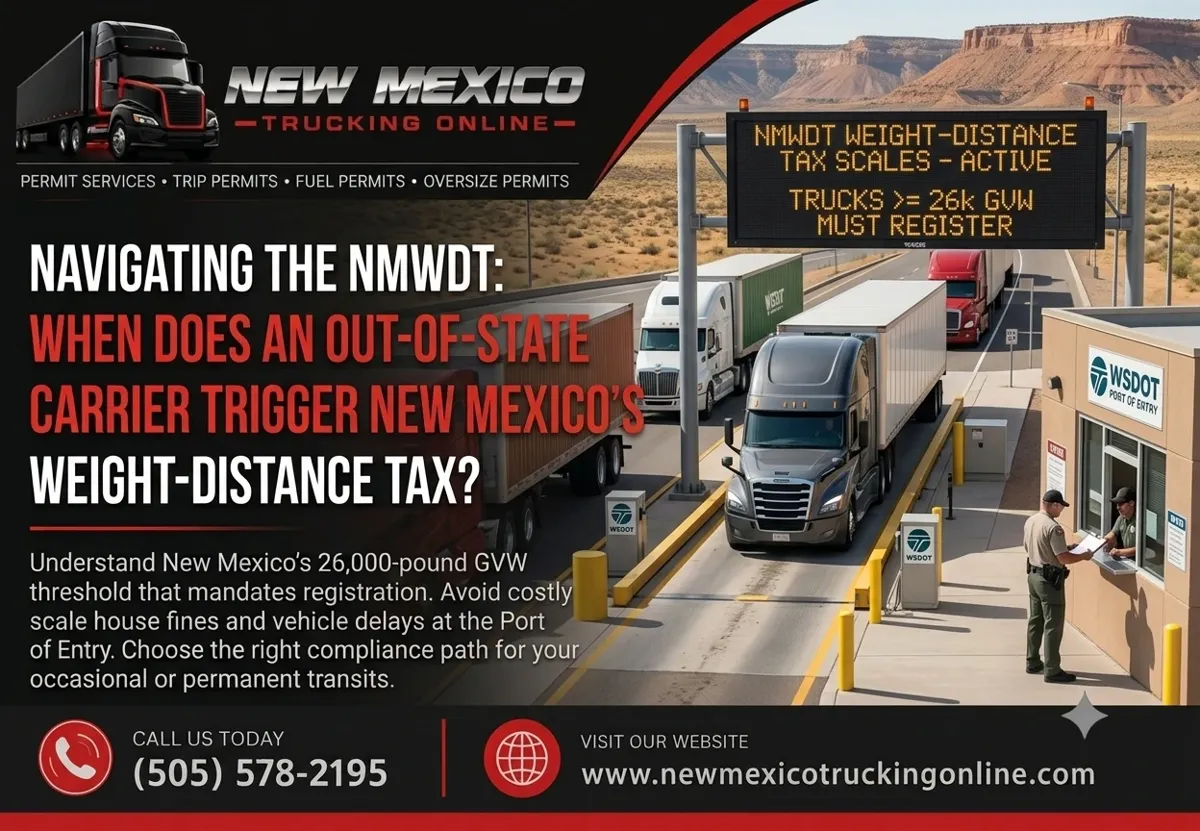
Navigating the NMWDT: When Does an Out-of-State Carrier Trigger New Mexico's Weight-Distance Tax?
Table of Contents
-
Introduction
-
What is the New Mexico Weight-Distance Tax?
-
When Does an Out-of-State Truck Trigger the Tax?
-
Annual Registration vs. Temporary Trip Permits
-
Quarterly Reporting Deadlines and Compliance Risks
-
Why Streamline Your New Mexico Permits With Us
-
Frequently Asked Questions
Introduction
Running freight across the Southwest means navigating a unique patch of regulatory territory. While most states rely primarily on standard registration and fuel tax reporting, New Mexico enforces an additional, distinct layer of compliance that catches many out-of-state fleet operators off guard.
If your commercial trucks cross into the Land of Enchantment, you cannot rely solely on your standard IRP and IFTA credentials to stay legal. Bypassing state lines without accounting for the New Mexico Weight-Distance Tax can trigger immediate enforcement actions, costly fines, and vehicle delays at the port of entry. This comprehensive guide walks you through the exact compliance thresholds, who is subject to the tax, and how to choose the right permit option for your fleet.
What is the New Mexico Weight-Distance Tax?
The New Mexico Weight-Distance Tax is a specialized mileage-based highway use tax imposed on commercial motor vehicles operating on New Mexico public roads. Unlike broad regional tax agreements, this specific fee is calculated using two primary data points: the total declared gross vehicle weight (GVW) of your configuration and the exact number of miles traveled within New Mexico borders.
The revenue generated from this program goes directly toward maintaining the state's highway infrastructure, meaning the state actively and aggressively enforces reporting accuracy at every scale house.
When Does an Out-of-State Truck Trigger the Tax?
Compliance with the New Mexico Weight-Distance Tax is not based on your home jurisdiction; it is triggered strictly by the physical characteristics of your vehicle and load.
-
The 26,000-Pound Threshold: Any intra- or interstate commercial vehicle or combination setup with a declared gross vehicle weight exceeding 26,000 pounds triggers the mandatory requirement.
-
Interstate and Intrastate Transit: Whether your truck is just cutting through the state on a long-distance cross-country haul or delivering multiple loads locally, you are subject to the tax regulations the moment your tires touch New Mexico pavement.
If your truck or tractor-trailer combo configuration operates at 26,000 pounds or less, you are exempt from this specific requirement.
Annual Registration vs. Temporary Trip Permits
Out-of-state carriers have two distinct methods to satisfy their state obligations. Choosing the right option depends entirely on how often your trucks route through the region.
The Annual WDT Electronic Permit
For fleets and owner-operators that regularly cross into New Mexico, setting up an official taxpayer account and securing an annual New Mexico Weight-Distance Tax electronic permit is the most cost-effective path. This permit must be renewed every calendar year by December 31st and requires the carrier to meticulously track and report in-state mileage every quarter.
The Temporary Trip Tax Permit Alternative
If your trucks only travel through the state infrequently or are executing a one-time single trip, setting up an ongoing tax account may create unnecessary paperwork. Instead, you can secure a temporary trip permit at the border or online before entry. This alternative provides temporary, short-term clearance for that specific haul, allowing you to pay your structural highway tax upfront without entering the quarterly reporting loop.
Quarterly Reporting Deadlines and Compliance Risks
If you opt for the annual registration, your work is not finished once the permit is printed and placed inside the truck cab. Carriers must file a weight-distance tax return on a strict quarterly basis, even if your trucks recorded zero miles in the state during that specific period.
The standard reporting windows are heavily enforced:
-
Q1 (Jan – Mar): Due April 30
-
Q2 (Apr – Jun): Due July 31
-
Q3 (Jul – Sep): Due October 31
-
Q4 (Oct – Dec): Due January 31
Failing to submit these mileage logs or missing payments carries heavy operational risks. The New Mexico Motor Vehicle Division (MVD) will issue late fees, add interest penalties, and automatically block your ability to renew your vehicle permits for the upcoming year. Even worse, outstanding tax issues can cause your trucks to be flagged and held at the Port of Entry during routine screening.
Why Streamline Your New Mexico Permits With Us
Juggling state mileage filings alongside standard IRP, IFTA, and federal requirements takes valuable dispatch time away from your core business. At New Mexico Trucking Online, we automate the administrative complexities to keep your fleet moving smoothly across state lines.
-
Fast-Track Processing: We secure your annual or temporary permits rapidly, ensuring your drivers have the documentation they need before hitting the scale houses.
-
Data Audit Protection: Our team reviews your declared gross vehicle weights and truck parameters to guarantee full compliance with New Mexico regulations, avoiding costly errors.
-
End-to-End Solutions: From ongoing weight-distance tax management to temporary fuel trip passes, we provide your operations with a reliable, stress-free compliance partner.
FAQ
Is the New Mexico Weight-Distance Tax covered under my IFTA account?
No. The International Fuel Tax Agreement (IFTA) only tracks and redistributes fuel consumption taxes. The New Mexico Weight-Distance Tax is completely separate and requires its own unique filing, permit tracking, and account reporting structure.
What happens if a truck enters the state without registering or getting a permit?
If a truck over 26,000 pounds bypasses the permit process, enforcement officers at the Port of Entry will issue severe structural fines. The vehicle will typically be detained or placed out of service on-site until the proper mileage tax obligations or trip fees are completely satisfied.
Are New Mexico WDT permits issued per fleet or per truck?
Permits are strictly vehicle-specific and tied directly to the individual vehicle identification number (VIN). You must secure a separate, valid document for every individual qualifying power unit in your fleet that operates within the state.