Impact of the Rail Industry on Trucking Logistics in New Mexico
1. Overview
New Mexico is a key freight transportation hub in the American Southwest, strategically positioned between Texas, Arizona, Colorado, and Mexico.
While trucking remains the dominant mode for short-haul and regional freight, the rail industry plays a vital complementary role — influencing how goods move through the state and across the U.S.-Mexico border.
The interaction between rail and trucking forms a multimodal logistics network, connecting industries like energy, manufacturing, agriculture, and retail to national and international markets.
2. New Mexico’s Rail Infrastructure
New Mexico hosts major rail corridors operated by:
-
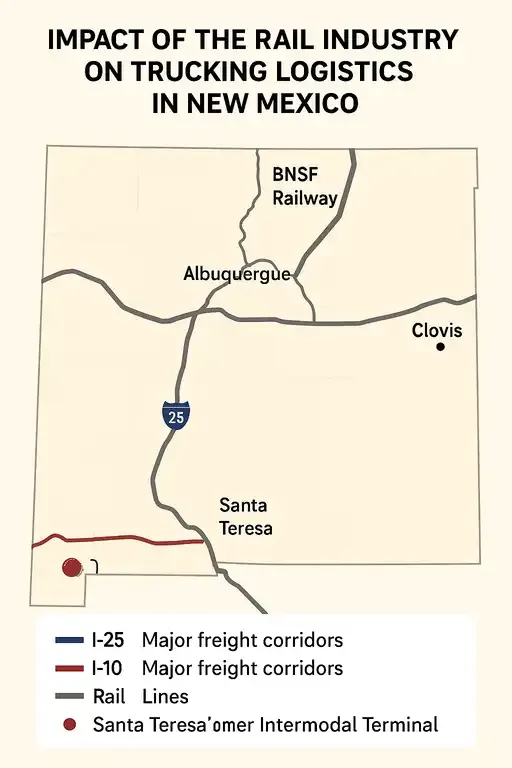
BNSF Railway — running a key transcontinental route (Chicago–Los Angeles) through Albuquerque, Gallup, and Clovis.
-
Union Pacific (UP) — operating its massive Santa Teresa Intermodal Terminal near the U.S.-Mexico border, one of the most advanced freight facilities in the region.
These rail lines are part of the NAFTA/USMCA trade corridor, carrying millions of tons of goods each year between Mexico, the U.S., and Canada.
3. The Trucking–Rail Relationship
Trucking and rail transport are not competitors, but partners in a shared logistics ecosystem.
-
Rail handles long-distance bulk and intermodal freight efficiently.
-
Trucking provides the critical first-mile and last-mile delivery to and from rail terminals, warehouses, and distribution centers.
In New Mexico, trucking companies often coordinate directly with rail yards in:
-
Santa Teresa (Union Pacific Intermodal Terminal)
-
Albuquerque (BNSF yard)
-
Clovis and Gallup (regional transfer hubs)
This cooperation allows freight to move seamlessly between rail and road, reducing transit times and transportation costs.
4. Santa Teresa: A Case Study in Intermodal Growth
The Santa Teresa Port of Entry and Intermodal Terminal near Las Cruces has transformed New Mexico’s freight economy.
-
Opened in 2014, the Union Pacific facility handles hundreds of thousands of containers per year, connecting directly to West Coast ports.
-
Trucking companies benefit from:
-
Shorter drayage routes to Mexico’s maquiladora (factory) zones.
-
Streamlined customs processing for international freight.
-
Reduced congestion compared to Texas border crossings (e.g., El Paso).
-
-
The site has attracted logistics parks, cross-docking warehouses, and industrial developers, expanding trucking demand in southern New Mexico.
5. Economic Impacts on Trucking
The growth of the rail industry impacts trucking in several ways:
✅ Positive Impacts:
-
Increases intermodal freight opportunities (trucks hauling containers to/from rail terminals).
-
Encourages regional distribution centers, creating more local haul routes.
-
Reduces highway congestion and emissions, allowing trucks to operate more efficiently.
Challenges:
-
Long-haul rail shipping can reduce the need for certain long-distance trucking jobs.
-
Delays or rail congestion can disrupt delivery schedules for connected truck carriers.
-
Competition for freight between rail and trucking can impact rates in some sectors.
6. Infrastructure and Technology Integration
Both industries are modernizing in parallel:
-
Intermodal facilities use digital tracking and scheduling systems to coordinate truck arrivals.
-
Electronic Data Interchange (EDI) connects rail and trucking logistics platforms for better visibility.
-
Smart routing and AI logistics software help carriers plan efficient routes based on rail schedules.
The New Mexico Department of Transportation (NMDOT) and New Mexico Border Authority are working to improve road access and infrastructure around rail terminals to support growing freight volumes.
7. Environmental and Sustainability Benefits
Combining rail and trucking has significant environmental advantages:
-
Rail can move one ton of freight over 470 miles per gallon of fuel, cutting emissions.
-
Fewer long-haul truck trips mean reduced highway wear and lower CO₂ output.
-
Trucks remain essential for short-haul distribution, especially for time-sensitive freight.
The state’s sustainability initiatives encourage a balanced logistics network where each mode operates at peak efficiency.
8. Future Outlook
As trade between the U.S. and Mexico expands under USMCA, New Mexico is poised to become a major logistics gateway.
-
Rail capacity will continue to grow, especially around Santa Teresa and Albuquerque.
-
Trucking companies will see rising demand for intermodal services and regional drayage.
-
Automation, green technology, and AI will streamline coordination between rail and trucking networks.
9. Key Takeaway
The rail industry isn’t replacing trucking in New Mexico — it’s enhancing it.
Together, they create a synergistic freight system that strengthens the state’s economy, supports cross-border trade, and paves the way for a more sustainable and connected future.
New Mexico’s success in freight logistics depends on one thing above all:
Efficient collaboration between trucks and trains — from the desert terminals to the national highways.