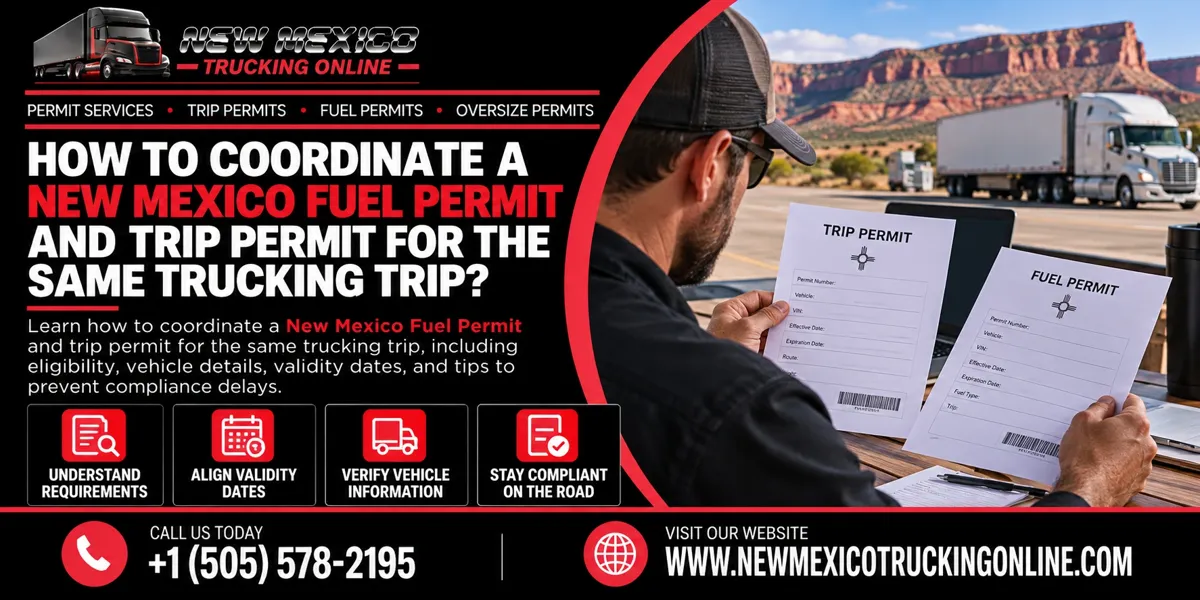
How To Coordinate A New Mexico Trip Permit And Fuel Permit For The Same Trucking Trip
Table Of Contents
-
Introduction
-
Understand What Each Permit Covers
-
Confirm Whether The Truck Needs Both Permits
-
Coordinate Dates And Entry Plans
-
Verify Vehicle And Carrier Information
-
What If The Trip Schedule Changes?
-
Keep Both Permits Accessible
-
Prevent Common Coordination Mistakes
-
Why Many Trucking Companies Choose Our Service
-
FAQ
Introduction
Carriers transporting freight through New Mexico may need more than one temporary credential, depending on the vehicle's registration status and fuel-tax coverage. A New Mexico Fuel Permit and a New Mexico trip permit address different requirements, so purchasing one does not automatically satisfy the other.
Identify the required credentials, compare their conditions with the itinerary, and verify the details before dispatch. This helps prevent document problems and avoidable delays.
Understand What Each Permit Covers
A New Mexico trip permit addresses trip-tax requirements for certain commercial vehicles not registered or licensed in the state that transport passengers or property for hire or resale. The tax is based on vehicle weight and New Mexico miles traveled.
A New Mexico Fuel Permit, also called a temporary special fuel user permit, covers fuel-tax authorization for qualifying commercial vehicles using special fuel. The temporary permit rules generally apply to covered vehicles over 26,000 pounds that are not registered with the department. Diesel is New Mexico's special fuel reported for IFTA purposes.
Because these permits serve different purposes, carriers should confirm whether both are required for their particular vehicle and operation rather than assuming every truck needs both.
Confirm Whether The Truck Needs Both Permits
Check the truck's registration, weight, axle configuration, fuel type, and fuel-tax credentials. A vehicle with valid coverage may not need a temporary fuel permit; one without required coverage may need it before operating.
Trip-tax and registration requirements are separate. An out-of-state truck may need registration or trip-tax authorization as well as fuel-tax coverage. If the status is unclear, verify requirements with the relevant state agency or permit provider before ordering.
Coordinate Dates And Entry Plans
Plan around the truck's actual entry and operating schedule. Do not assume the two documents have matching validity periods just because they are purchased on the same day.
New Mexico's temporary special fuel user permit is generally valid for one calendar day or for one entry into and one exit out of the state. Trip-tax arrangements may follow separate issuance and payment procedures. Check the dates and conditions printed on each credential and make sure they cover the planned movement as required.
If arrival is near midnight or the truck will enter more than once, confirm how the permit terms apply before departure.
Verify Vehicle And Carrier Information
Compare both permits with the truck's registration and dispatch records. Check the VIN, license plate, carrier information, weight, and other requested details to catch mismatches before inspection.
Do not assume that a permit purchased for one truck can be transferred to a substitute vehicle. If equipment changes, confirm with the issuing office whether new authorization is needed. Never hand-edit dates or vehicle identifiers on an issued permit.
What If The Trip Schedule Changes?
Loading delays, breakdowns, or changes to a delivery schedule may affect when the truck enters or travels through New Mexico. If the itinerary shifts, review both permits rather than checking only one document.
If either permit no longer covers the intended operation, contact the appropriate provider or state office before proceeding. A purchase receipt or application confirmation should not be treated as a substitute for the required issued credential. Ask how to correct the situation instead of assuming the original permit can be extended or reused.
Keep Both Permits Accessible
Make sure the driver can access readable copies of all required credentials. Dispatch should retain both permits, purchase confirmations, vehicle details, and the planned entry information.
For fleets, a shared tracking log can match each permit to its truck, purchase date, and validity conditions, reducing duplicate orders and missing documents.
Prevent Common Coordination Mistakes
Assuming One Permit Covers Both Requirements: Trip-tax and fuel-tax credentials serve different purposes. Confirm each requirement separately.
Using Matching Purchase Dates As Proof Of Coverage: Read the validity conditions on both issued documents.
Ignoring Vehicle Details: Compare the permit information with the actual truck and registration records.
Overlooking A Schedule Change: Recheck the trip and fuel permits if the entry date or itinerary changes.
Waiting Until The Port Of Entry: Resolve unclear credentials before dispatch whenever possible.
Changing Permit Information Yourself: Contact the issuing authority if a document contains incorrect information.
Why Many Trucking Companies Choose Our Service
Many trucking companies choose New Mexico Trucking Online because managing multiple credentials can be time-consuming when dispatch schedules and vehicle records change.
Our service helps carriers save time, simplify permit processes, reduce paperwork issues, and review permit information. Fast processing and dedicated customer support help companies organize trip documents and address questions before delays arise.
FAQ
Do I Always Need A New Mexico Trip Permit And Fuel Permit Together?
Not always. The requirements depend on the truck's registration status, use, weight, fuel type, and existing tax credentials.
Do The Two Permits Have The Same Validity Period?
Not necessarily. Check the validity dates and conditions on each credential individually.
How Long Is A Temporary New Mexico Fuel Permit Valid?
It is generally valid for one calendar day or one entry and exit from New Mexico. Verify the conditions on the issued permit.
What Vehicle Details Should I Check?
Compare the VIN, license plate, carrier details, weight information, and other requested data with the vehicle records.
What If The Truck's Arrival Date Changes?
Review both permits and contact the appropriate provider or agency if either credential may not cover the revised trip.
Can I Use The Same Permits For A Different Truck?
Do not assume so. Confirm whether the permits apply to the replacement vehicle before it operates in New Mexico.
What Should Dispatch Keep On File?
Retain copies of both permits, purchase confirmations, vehicle information, validity conditions, and trip details.
For more information, visit the New Mexico Motor Vehicle Division.