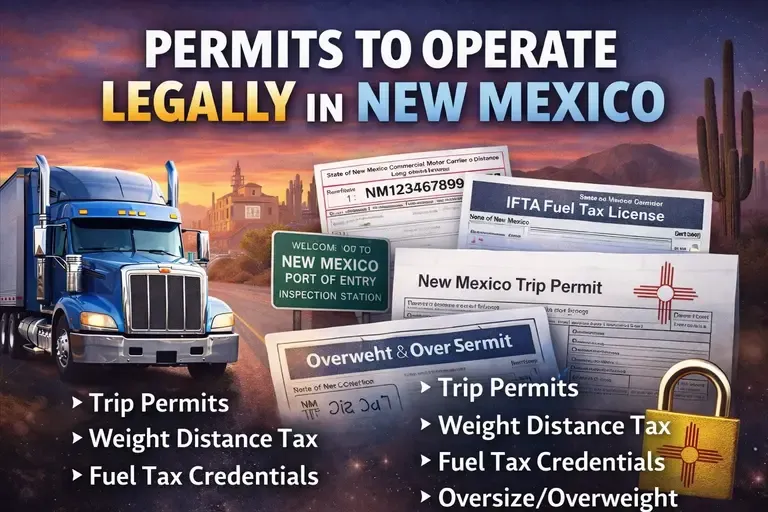
1. Understand New Mexico’s Weight Distance Tax (WDT)
New Mexico requires carriers operating vehicles over 26,000 lbs to register for the Weight Distance Tax Permit.
This applies even if you are an out-of-state company and you only travel through New Mexico occasionally.
You must either:
Option A: Register for a permanent WDT account, or
Option B: Purchase a temporary WDT permit (usually valid for one trip)
Failing to secure a WDT permit before operating in the state can result in:
-
penalties
-
delays at Ports of Entry
-
suspension from future NM operations
2. Stop at All Required New Mexico Ports of Entry
New Mexico requires virtually all commercial carriers, especially those entering from out of state, to stop at the first Port of Entry they encounter.
Officers will check:
-
USDOT registration
-
MC operating authority
-
WDT credentials
-
IFTA license and decals
-
Trip or Fuel permits (if needed)
-
Safety and equipment compliance
-
Bill of lading
Carriers who fail to stop can face immediate fines or mandatory inspection stops.
3. Secure a New Mexico Trip Permit if You Don’t Have IFTA
If your truck is:
-
not registered under IFTA, or
-
the IFTA sticker is expired
You must buy a New Mexico Fuel Trip Permit to operate legally in the state.
This applies to:
-
rental or leased units
-
borrowed trucks
-
newly acquired vehicles not yet added to your IFTA account
4. Get an OSOW Permit for Oversize or Overweight Loads
Out-of-state carriers transporting oversize/overweight loads must obtain:
-
a New Mexico OSOW Single-Trip Permit, or
-
an Annual OSOW Permit (if traveling frequently)
New Mexico enforces strict limitations on:
-
height
-
width
-
length
-
axle weights
-
required pilot cars
-
restricted routes and curfews
Always check current routing rules—New Mexico heavily enforces OSOW compliance.
5. Understand Proof of Financial Responsibility Requirements
New Mexico DOT may request proof of insurance at the Port of Entry.
Minimum federal coverage applies:
-
$750,000 liability minimum for standard freight
-
$1,000,000—for oilfield, hazmat, or certain specialized commodities
-
$5,000,000—for high-risk hazardous materials
Always keep a digital or paper certificate ready for review.
6. Keep Accurate Mileage for WDT Calculations
If you operate under a permanent New Mexico WDT account, you must:
-
Report miles traveled only within New Mexico
-
File returns monthly or quarterly
-
Maintain accurate driver logs and trip sheets
Poor recordkeeping leads to incorrect tax filings, which may trigger audits or penalties.
7. Ensure Your Equipment Meets NM Safety Requirements
New Mexico routinely performs full inspections at POEs.
Officers may check:
-
brakes
-
tires
-
lights and reflectors
-
logbooks or ELD
-
trailer attachments
-
hazmat documents (if applicable)
Being inspection-ready helps avoid delays and citations.
8. Use Temporary Permits for One-Time or Occasional Trips
If you only travel through New Mexico once in a while, using temporary permits is the easiest option.
Temporary permits include:
-
WDT Temporary Permit
-
Trip (Fuel) Permit
-
Oversize/Overweight Single-Trip Permit
This avoids registering for a full WDT account unless needed.
9. Maintain Proper IFTA and IRP Credentials
New Mexico checks both IFTA and IRP compliance at Ports of Entry.
You must display:
-
valid IFTA decals
-
IFTA license in cab
-
IRP cab card for apportioned plates
If your IRP registration doesn’t include New Mexico, you’ll need a New Mexico Trip Permit.
10. Work With a Permit Service to Avoid Delays
Because New Mexico is one of the strictest states for entry compliance, many carriers use a professional permitting service to handle:
-
WDT accounts
-
temporary permits
-
OSOW routing
-
tax filings
This prevents fines, delays, and rejected entries at Ports of Entry.
Bottom Line
Out-of-state carriers can operate legally in New Mexico by securing:
WDT permit (permanent or temporary)
IFTA or fuel permit
Trip permits when required
OSOW permits for heavy hauls
Proper documentation for Ports of Entry
With the correct credentials in place before entering, carriers can move smoothly across New Mexico without penalties or delays.