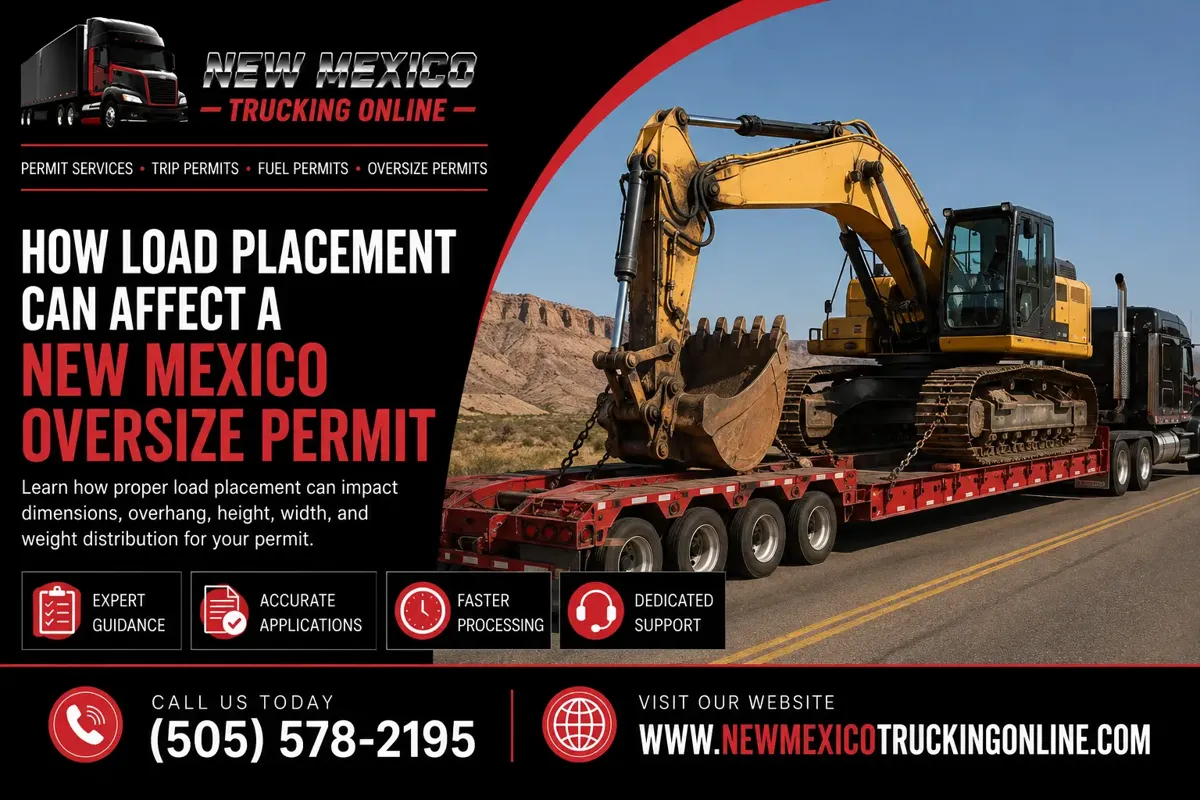
How Load Placement Can Affect A New Mexico Oversize Permit
Table Of Contents
-
Introduction
-
Why Load Placement Matters
-
How Load Placement Affects Overall Width
-
How Load Placement Affects Height
-
How Load Placement Affects Length And Overhang
-
How Load Placement Affects Weight Distribution
-
Choosing The Right Trailer Configuration
-
What To Check Before Applying
-
Common Load Placement Mistakes To Avoid
-
Why Many Trucking Companies Choose Our Service
-
FAQ
Introduction
When preparing to apply for a New Mexico oversize permit, trucking companies need to consider more than the size of the cargo itself. The way a load is positioned on the trailer can change the overall dimensions and weight distribution of the complete vehicle.
Moving a piece of equipment forward, backward, sideways, or higher on the trailer can affect its overall width, height, length, and overhang. It can also change how weight is distributed across the axles.
For this reason, load placement should be determined before submitting an oversize permit application. A carefully planned configuration can help ensure that the information provided accurately represents the vehicle and load that will travel.
Why Load Placement Matters
The same piece of equipment can produce different transportation measurements depending on how it is positioned.
For example, placing equipment closer to one end of a trailer may increase front or rear overhang, while positioning it differently may change the overall height or weight distribution. A load that appears to fit one trailer configuration may require different considerations when placed on another.
Accurate load placement also helps trucking companies provide more reliable information when preparing a permit application. The goal is to make sure the dimensions and configuration submitted reflect the actual movement.
How Load Placement Affects Overall Width
Load placement can affect how much of the cargo extends beyond the sides of the trailer.
Some equipment has an irregular shape, with certain components wider than others. If the widest part of the equipment is positioned differently, the overall width of the loaded vehicle may change.
Before applying, identify the widest point of the complete configuration. Consider the trailer, cargo, attachments, and any components that extend beyond the trailer deck.
Avoid assuming that the manufacturer's equipment width is automatically the same as the final transportation width. The position of the equipment on the trailer should also be considered.
How Load Placement Affects Height
Height is another important consideration when positioning oversized equipment.
The height of the loaded vehicle depends on the distance from the roadway to the highest point of the complete configuration. Trailer deck height, suspension, cargo orientation, and the position of elevated equipment can all influence the final measurement.
For equipment with removable or adjustable components, carriers should determine how those components will be positioned during transportation.
A small change in load orientation can sometimes create a significant difference in overall height. Measuring the completed configuration after loading helps ensure that the permit application reflects the actual height of the movement.
How Load Placement Affects Length And Overhang
Long equipment may extend beyond the front or rear of the trailer. Where the cargo is positioned can determine how much of that equipment projects beyond the trailer.
Moving the cargo forward can reduce rear overhang while increasing the amount extending toward the front. Moving it backward can have the opposite effect.
This makes load placement especially important for long machinery, beams, poles, structural components, and other extended cargo.
Before applying for a New Mexico oversize permit, trucking companies should determine the overall length and applicable projections based on the actual planned configuration.
How Load Placement Affects Weight Distribution
Load placement does not only affect dimensions. It can also affect how weight is distributed across the vehicle's axles.
A heavy piece of equipment positioned too far forward or too far toward the rear can change the amount of weight carried by different axle groups. This may create a configuration that requires additional consideration even when the total gross weight has not changed.
Trucking companies should therefore consider axle spacing, axle configuration, trailer type, cargo weight, and the planned position of the load together.
The weight information submitted for permitting should correspond to the configuration that will actually be transported.
Choosing The Right Trailer Configuration
The trailer itself can influence how an oversize load must be positioned.
Different trailers provide different deck heights, lengths, widths, and axle configurations. A trailer that works well for one piece of equipment may not be the best option for another.
Before loading, consider whether the selected trailer provides enough deck space and allows the cargo to be positioned appropriately without creating unnecessary overhang or clearance concerns.
For unusually heavy or large equipment, trucking companies should evaluate the complete combination before finalizing the configuration. Choosing the appropriate trailer at the beginning can make it easier to establish accurate dimensions and weight information.
What To Check Before Applying
Before submitting a New Mexico oversize permit application, trucking companies should review the complete loaded configuration.
Check:
-
Overall width
-
Overall height
-
Overall length
-
Front overhang
-
Rear overhang
-
Gross vehicle weight
-
Individual axle weights
-
Axle spacing
-
Number of axles
-
Trailer configuration
-
Cargo position
-
Load securement
The measurements should be taken from the configuration that will actually be used for the trip.
If the cargo is repositioned after the measurements are recorded, the dimensions and weight distribution should be reviewed again. Changes to the configuration can affect the information used for permitting.
Common Load Placement Mistakes To Avoid
Positioning cargo without checking overhang: Long equipment can create significant front or rear projections when it is moved along the trailer.
Ignoring trailer deck height: A taller trailer can increase the final height of the loaded vehicle.
Measuring before final positioning: Measurements can change after the cargo is shifted or secured.
Focusing only on total weight: Gross weight alone does not describe how the load is distributed across the axles.
Using the same configuration for every trailer: Different trailers can produce different overall dimensions.
Ignoring unusual equipment shapes: Irregular machinery can have components that extend beyond the main body.
Failing to recheck after adjustments: Any major change in load position should be followed by another review of the dimensions and weight distribution.
Careful planning before the permit application can help trucking companies avoid using information that does not match the actual vehicle configuration.
Why Many Trucking Companies Choose Our Service
Many trucking companies choose New Mexico Trucking Online because preparing an oversize permit application requires accurate information about the vehicle, trailer, cargo, and planned configuration. Our experienced permit specialists help trucking companies organize the necessary information and handle the permitting process efficiently.
With fast processing, 24/7 customer support, weekend and holiday availability, a secure online application, competitive pricing, and experienced permit specialists, New Mexico Trucking Online provides a convenient way to manage oversize permit applications. Our team helps trucking companies save time, reduce avoidable application issues, and keep their permit process organized from start to finish.
Apply for your New Mexico oversize permit today.
FAQ
Can load placement affect a New Mexico oversize permit?
Yes. The position of cargo can affect overall width, height, length, overhang, and weight distribution.
Does moving cargo on the trailer change its dimensions?
It can. Moving long or irregularly shaped cargo may change front and rear overhang and, depending on the equipment, other overall dimensions.
Can load placement affect axle weights?
Yes. Moving a heavy load forward or backward can change how weight is distributed among the vehicle's axle groups.
Should I measure the load before or after positioning it?
Measurements should be verified after the cargo has been placed in its planned transportation position so the final configuration can be accurately represented.
Does trailer selection affect load placement?
Yes. Trailer deck height, length, width, and axle configuration can affect how the cargo can be positioned and the resulting dimensions of the complete vehicle.
What should I do if I reposition the load after applying?
Review the complete configuration again. A significant change in load position can affect the information used for the permit application.
Why is accurate load placement important?
Accurate placement helps trucking companies determine the actual dimensions and weight distribution of the vehicle and load, making it easier to provide correct information during the permitting process.
For more information, visit the New Mexico Department of Transportation.