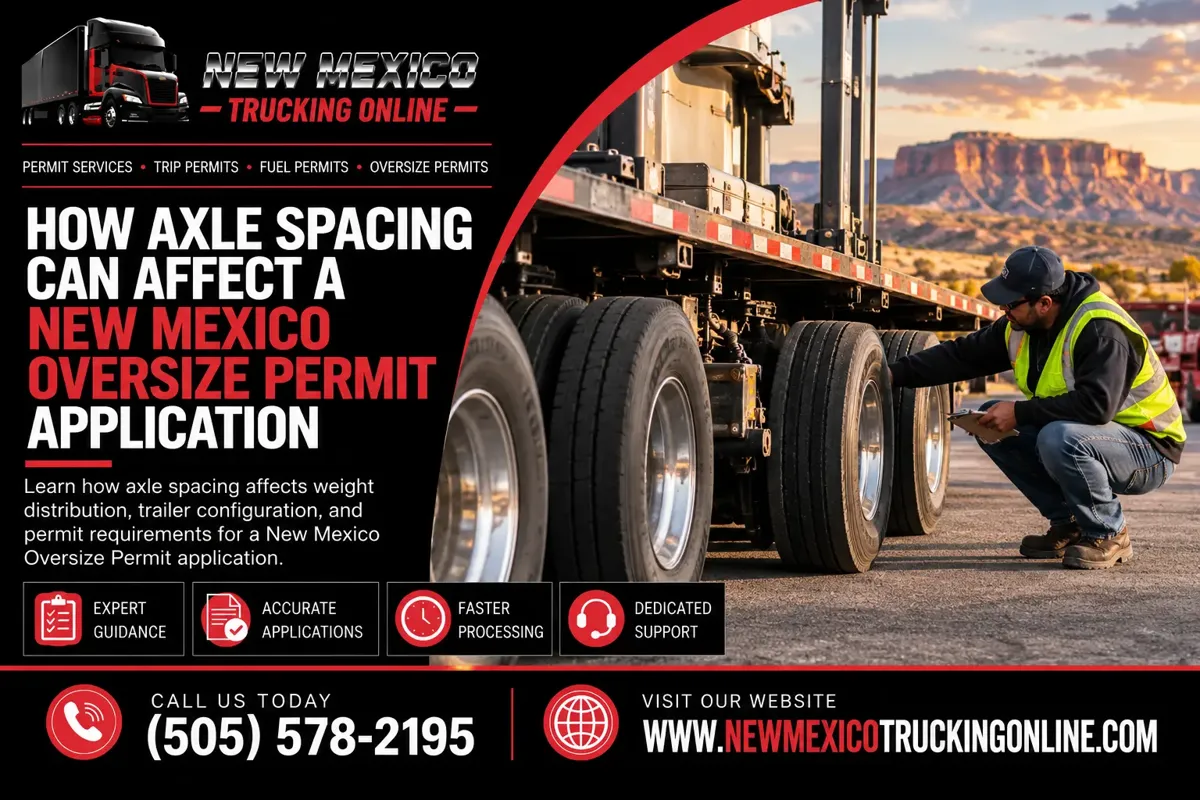
How Axle Spacing Can Affect A New Mexico Oversize Permit Application
Table Of Contents
-
Introduction
-
Why Axle Spacing Matters
-
How Axle Spacing Affects Weight Distribution
-
Trailer Configuration And Axle Spacing
-
What To Verify Before Applying
-
Common Mistakes To Avoid
-
Why Many Trucking Companies Choose Our Service
-
FAQ
Introduction
When preparing a New Mexico Oversize Permit application, trucking companies need to consider more than the overall size of the cargo. For heavy or unusual loads, the distance between axles can affect how weight is distributed across the vehicle and how the complete combination should be evaluated.
Two trucks can carry the same equipment but use different axle arrangements. One may distribute the load more effectively than another. A change in spacing can therefore affect weight calculations, trailer selection, and permit planning.
Checking axle spacing before applying helps trucking companies build an accurate picture of the truck, trailer, cargo, and intended route.
Why Axle Spacing Matters
Axle spacing matters because weight rules consider both the amount of weight being carried and how that weight is distributed.
The distance between axles can influence how much weight an axle group or combination can carry under applicable bridge and axle limitations. Closely spaced axles place weight over a smaller area, while greater spacing can spread the load across a longer section of the vehicle.
For permit planning, the number of axles alone is not enough. Carriers should also know where the axles are positioned and how far apart they are.
This becomes especially important when transporting heavy machinery, construction equipment, industrial components, or other loads that may require overweight authorization along with an oversize permit.
How Axle Spacing Affects Weight Distribution
A heavy load does not place equal weight on every axle. Cargo position, trailer design, axle location, and spacing all influence the final distribution.
For example, moving a large piece of equipment toward the rear of a trailer can increase the weight carried by rear axles. Moving it forward can shift more weight toward the tractor and front portion of the combination.
The spacing between axles also matters because certain weight assessments depend on the distance across an axle group. A different spacing arrangement can therefore change the result even when the cargo itself has not changed.
That is why trucking companies should review axle weights and spacing together. Looking only at gross vehicle weight can overlook an axle-group issue.
Trailer Configuration And Axle Spacing
Trailer selection is closely connected to axle spacing. Different trailers can have different axle locations, deck lengths, and load-carrying arrangements.
A lowboy, flatbed, or specialized heavy-haul trailer may distribute the same cargo differently. Sliding axles can also change spacing and shift weight from one axle group to another.
Because of this, the trailer planned for the move should match the configuration used for permit preparation as closely as possible.
If a trailer or tractor is changed before the trip, the carrier should review the new setup again. The axle count, spacing, cargo position, individual axle weights, and gross weight should reflect the configuration that will actually travel.
A similar trailer does not necessarily create an identical weight distribution.
What To Verify Before Applying
Before submitting a New Mexico Oversize Permit application, trucking companies should verify the complete loaded combination.
Check:
-
Number of axles
-
Distance between applicable axles
-
Individual axle weights
-
Gross vehicle weight
-
Tractor and trailer configuration
-
Cargo weight
-
Cargo position
-
Overall width, height, and length
-
Front and rear overhang
-
Planned route and destination
These details should be based on the actual transportation plan rather than rough estimates.
For a heavy load, carriers should also review whether the axle arrangement creates additional weight or bridge considerations. Accurate information at the application stage can reduce the chance of discovering a configuration problem after loading.
Common Mistakes To Avoid
One common mistake is focusing only on total weight. A vehicle can have a manageable gross weight while still placing too much weight on a particular axle or group.
Another mistake is assuming that adding axles automatically makes a configuration suitable for heavier cargo. Axle count, spacing, and distribution all work together.
Carriers should also avoid relying on old measurements after changing equipment. Replacing a trailer, sliding an axle group, or changing cargo position can alter the complete configuration.
Before applying, review the vehicle exactly as it is expected to travel. Confirm the axle arrangement, spacing, weights, dimensions, and cargo position.
A few minutes of careful planning can help prevent confusion later in the permitting process.
Why Many Trucking Companies Choose Our Service
Applying for a New Mexico Oversize Permit can become more complicated when a load has a heavy or specialized axle configuration. New Mexico Trucking Online helps trucking companies manage permit applications with fast processing, 24/7 customer support, weekend and holiday availability, secure online application, competitive pricing, and experienced permit specialists.
Our service helps trucking companies organize the information needed for the planned move and reduce delays caused by incomplete or inconsistent application details.
FAQ
Can axle spacing affect a New Mexico Oversize Permit application?
Yes. Axle spacing can affect weight distribution and how the complete vehicle configuration is evaluated.
Does adding more axles always allow more weight?
No. Axle count is only one factor. Spacing, individual axle weights, axle groups, and gross weight also matter.
Can moving an axle change the permit planning?
Yes. Changing axle position can change spacing and weight distribution, so the configuration should be reviewed again.
Does cargo placement affect axle weights?
Yes. Moving heavy cargo forward or backward can shift weight between axle groups.
Should axle spacing be checked before applying?
Yes. Verifying spacing beforehand helps ensure that the application reflects the vehicle and load that will actually travel.
What if the carrier changes trailers after preparing the application?
The replacement trailer should be reviewed to confirm that its axle count, spacing, weights, and overall configuration still match the planned move.
For more information, visit the New Mexico Department of Transportation.