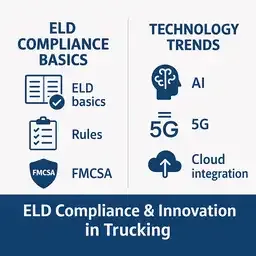
What Is ELD & Why It Matters
-
ELDs are devices that automatically record a driver’s Hours of Service (HOS) records of duty status (RODS), synchronizing with the vehicle’s engine to log driving time.
-
The ELD mandate was introduced by FMCSA under MAP-21 to improve road safety by ensuring drivers take required rest breaks and have accurate logging.
Compliance Requirements (FMCSA & Key Rules)
-
Who Must Use an ELD
-
Any driver who currently is required to keep RODS under the HOS regulations (i.e., many interstate commercial drivers).
-
Certain exceptions apply, like drivers who keep paper logs for no more than 8 days in a 30-day period, and drive-away / tow-away drivers if the vehicle driven is part of the shipment.
-
-
Device Requirements
-
Only devices that are registered & self-certified with FMCSA may be used.
-
ELDs must meet technical specifications (as per 49 CFR Part 395, Subpart B) such as recording engine power on/off, vehicle motion, miles driven, engine hours, and more.
-
-
Data & Records
-
Drivers / carriers must keep supporting documents (like fuel receipts, dispatch records) that validate hours driven.
-
Enforcement officers must be able to access/display the logs, sometimes even from outside the cab if certain display requirements apply.
-
-
Exemptions & Special Cases
-
Agricultural drivers under certain conditions.
-
Existing Automatic On-Board Recording Devices (AOBRDs) had a grandfather period, but most have now been phased out or must comply with ELD standards.
-
-
Recent Removals / Enforcement
-
Some ELD models have been removed from the FMCSA Registered ELD list because they failed to maintain compliance. Carriers must replace non-eligible devices.
-
Technology Trends & Innovations in ELDs
Here are some of the emerging and growing trends in ELD technology:
| Trend | Description / Potential Benefits |
|---|---|
| AI / Machine Learning | Used to analyze driver behavior (harsh braking, speeding), detect patterns indicating fatigue, offer predictive maintenance of vehicles, and optimize fuel usage. |
| 5G & Enhanced Connectivity | Faster data transfer enables near-real-time monitoring, transmission of larger data volumes (video, telematics), and better remote diagnostics. |
| Integration with Fleet Management / Telematics Systems | Unified dashboards combining ELD data with GPS tracking, route planning, vehicle diagnostics, etc. This improves decision making and operational efficiency. |
| Cloud-Based & Mobile Applications Interfaces | More ELD solutions are using cloud storage, mobile apps with improved UX, push notifications, alerts, and more intuitive driver interfaces. |
| Data Security & Compliance Enhancements | As data gets shared and accessed more often, encryption, secure authentication, integrity of log data, and privacy of drivers are becoming more important. |
| EV-Friendly & Environmental Features | With electric trucks growing, ELD/telematics systems are adapting to include battery health, range optimization, charging schedule integrations. |
Challenges & Considerations
-
Cost & Device Upgrades: Many fleets are upgrading older 3G based devices to newer networks and firmware. The cost of replacing/maintaining ELD hardware and subscriptions can be significant.
-
Device Reliability & Certification: Some manufacturers fail to keep devices in compliance; removal from FMCSA list means carriers need to find replacements quickly
-
Driver Training & Adoption: Drivers need to understand how to properly use devices, how to handle errors, data validation, etc. Poor UX can lead to frustration or misuse.
-
Data Overload & Management: With more sensors, telemetry, and connected systems, there is more data than ever; fleet staff need tools and training to turn that into actionable insights rather than noise.
What Carriers Should Do Now to Stay Ahead
-
Audit your ELD hardware/software — Ensure it's on FMCSA’s current certified list and meets all technical specs.
-
Plan for upgrades — If using older devices (3G or otherwise), check vendor’s roadmap for updates or replacements.
-
Use integrated systems — Combine ELDs with route-planning, fuel management, safety analytics to gain efficiency and reduce costs.
-
Train drivers & staff — Good training and support reduce errors, violations, and improve safety culture.
-
Monitor regulatory updates — FMCSA periodically removes devices, updates HOS rules, or issues guidance. Staying current avoids penalties.