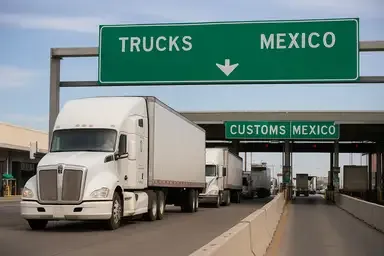
Why It’s a Big Opportunity
-
Freight between the U.S. and Mexico has been growing: as of recent data, truck freight across the U.S.–Mexico corridor is valued in the tens of billions annually.
-
Mexico has become a major manufacturing and export hub, especially in sectors like automotive, electronics, and parts. That means inbound and outbound freight flows are increasing.
-
The “nearshoring” trend (moving manufacturing closer to the U.S.) boosts cross-border trucking demand.
-
For carriers, this opens up routes, new lane opportunities, higher revenue potential — if you can navigate the complexities.
Key Operational Models
-
Through-Trailer/Seamless Service Model: A U.S. trailer is loaded in the U.S., crosses the border (via a Mexican carrier partner) and delivers in Mexico (or vice versa) without cargo transfer. This model increases efficiency.
-
Transfer/Drayage Model: A U.S. truck brings freight to the border; a Mexican carrier takes over (or vice versa). This involves a transfer at the border yard.
-
Brokered Consolidation & LTL Services: For smaller shipments (less than full-truckload), carriers and brokers consolidate freight to make cross-border moves more cost-effective.
Regulatory & Compliance Highlights
-
Carriers operating U.S.–Mexico must meet U.S. safety and operational standards: For example, Mexican-domiciled carriers with U.S. authority must pass a safety audit, have DOT/MC-type registration, and comply with U.S. hours-of-service rules.
-
Certification such as Customs‑Trade Partnership Against Terrorism (CTPAT) may be required or highly advantageous for cross-border freight due to security & insurer expectations.
-
Understanding customs/brokerage, duties, inspection points, and documentation is critical. Delays at the border can impose time and cost penalties.
Key Challenges & Risks
-
Border Delays & Congestion: Long wait times at ports of entry increase costs and reduce reliability.
-
Cargo Theft / Security Risks: Cross‐border shipments may face heightened risk depending on route, partner carrier, type of freight. From industry discussion:
“Smart carriers / brokers go around the cartel areas… you need to find a carrier with multiple years of border crossing experience…”
-
Partner/Interchange Complexity: Aligning U.S. and Mexican carriers, managing legal jurisdiction, tractor/trailer ownership, licensing, etc., adds operational complexity.
-
Regulatory Differences: Differences between U.S. and Mexican regulations (vehicle standards, driver licensing, hours, liability) mean stricter compliance protocols.
-
Under-utilisation: Some cross-border operations suffer from low trailer utilization (e.g., moving a single pallet across the border), which reduces margin.
Opportunity Zones & Commodities
-
Major crossing hubs: e.g., Laredo, Texas / Nuevo Laredo, Tamaulipas, El Paso, Texas / Ciudad Juárez, Chihuahua. These are key gateways for truck freight between the two countries.
-
Commodities: automotive parts, electronics, machinery, building materials. As per a report: US-Mexico FTL freight had major share in these freight types.
Practical Tips for Carriers & Brokers
-
Vet your Mexican partner carriers: Ensure they have the necessary certifications, safety protocols, insurance, and experience in cross-border operations.
-
Optimize trailer utilisation: Avoid crossing for tiny loads unless the margin justifies the extra cost and complexity.
-
Plan for border delays: Build slack in schedules or choose crossings/times with lower congestion risk.
-
Stay compliant and updated: In both U.S. & Mexico. This includes driver licensing, vehicle standards, security programs.
-
Use technology & visibility: Real-time location/tracking, customs clearance visibility, proactive alerts help smooth operations and build service reliability.
-
Understand cost structure: Tariffs, customs duties, trans-load costs, inter-carrier handoffs add layers of cost that must be factored into quotes and margins.