Why It Matters
-
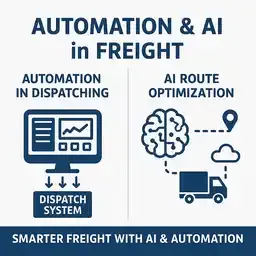
Dispatching and route planning are core operations for trucking companies: decisions about which truck takes which load, how to sequence stops, how to route around traffic or weather, how to minimize empty (“dead-head”) miles, etc.
-
Traditional methods often rely on manual spreadsheets, static rules, or human dispatchers juggling many variables — which can lead to inefficiencies, higher costs, slower response, and under-utilised assets.
-
AI and automation allow these planning processes to be scaled, enhanced with real-time data, and continuously optimised for changing conditions (traffic, weather, load availabilities). This boosts efficiency, reduces cost, and improves service levels.
Key Benefits
-
Reduced fuel & operating costs: Because routes are optimised to avoid unnecessary mileage, idling, and empty runs.
-
Better fleet and asset utilisation: AI can better assign loads to trucks, match truck capacity to loads, optimise sequencing and routing so fewer trucks do more work.
-
Faster, more accurate dispatching: AI can sift through load boards, driver availability, truck locations, and other data far faster than humans, enabling quicker decisions and fewer delays. Improved service & reliability: With smarter routing and dispatching, companies can provide tighter delivery windows, improve on-time performance, and provide better real-time visibility.
-
Reduced driver fatigue and improved safety: By avoiding inefficient routing, reducing unexpected delays, and aligning routes with driver hours-of-service rules.
Key Technologies & Approaches
-
AI-driven dispatch engines: These systems ingest data such as load requests, truck & driver availability, capacity, location, traffic, weather, road conditions, and then automatically assign trucks and sequence loads based on optimisation criteria (cost, time, utilisation).
-
Route optimisation algorithms: Using machine learning (ML) and advanced heuristics (sometimes graph-neural-networks, reinforcement learning) to evaluate many potential routes considering distance, time windows, traffic, vehicle constraints, fuel, etc.
-
Real-time data integration: Dispatch and route systems pull live data — e.g., GPS/telematics from trucks, traffic updates, weather changes, load board updates — which enables dynamic rerouting, reassignment, and decision making.
-
Automation of dispatch workflow and paperwork: AI can automate parts of the workflow: scanning load boards, matching loads, generating assignments, sending communications to drivers, generating documentation.
-
Predictive analytics & continuous learning: Systems learn from past performance, driver behaviour, delays, route outcomes – to refine future dispatch and routing decisions.
Implementation Considerations & Challenges
-
Data quality and integration: AI systems rely on accurate real-time and historical data. Incomplete, inconsistent, or siloed data undermines decision quality.
-
Change management: Dispatchers, drivers, and fleet managers need to adopt new workflows and trust AI recommendations. Poor implementation or lack of training can lead to push-back or misuse.
-
Complex constraints and customisation: Trucking has many constraints: driver hours, legal regulations, vehicle types, load size/weight, routes that allow trucks, etc. AI systems must account for these.
-
Scalability and cost-benefit: Smaller fleets may find cost or complexity of AI/automation systems prohibitive initially. ROI depends on volume, flexibility, and operational size.
-
Human oversight still essential: While AI can make recommendations, human judgement remains important — especially for exceptions, client relations, unforeseen events. Many companies emphasise “AI-assisted” rather than “AI-replaced” dispatch.
What the Future Looks Like
-
Wider adoption of autonomous dispatch systems where AI handles most of the assignment, routing, and monitoring, with humans stepping in for exceptions.
-
Integration with other technologies — e.g., autonomous trucks, IoT sensor networks, digital twins of fleet operations, deeper predictive analytics for vehicle condition and logistics flows.
-
More dynamic and driver-centric routing: AI systems might optimise not just for cost/time but for driver preferences, fatigue, safety, and sustainability objectives.
-
Increased focus on sustainability: AI routing and dispatch will also emphasise reducing emissions, selecting lower-carbon routes, consolidating loads, and utilising alternative-fuel vehicles.