What’s Driving Change
-
The Advanced Clean Trucks and Advanced Clean Cars II standards in New Mexico will require that 15% of new heavy-duty trucks sold to dealers in the state be zero-emission vehicles (ZEVs) starting with certain model years.
-
The state’s alternative fuels program through the New Mexico Energy, Minerals & Natural Resources Department (EMNRD) promotes alternative fuel vehicle adoption and infrastructure development (electric, hydrogen, natural gas) for commercial and public fleets.
-
Funding is being committed: For example, the New Mexico Department of Transportation (NMDOT) has secured millions in federal grants for EV infrastructure under its “Electrifying New Mexico” initiative.
-
Real-world deployments are beginning: For instance, the non-profit Goodwill Industries of New Mexico introduced fully electric semi-tractors in its fleet.
How It Affects Trucking & Freight
-
Zero-Emission Heavy-Duty Trucks (Class 7/8): Carriers operating in New Mexico can expect increasing availability and requirement of electric heavy-duty trucks as manufacturers comply with the new standards.
-
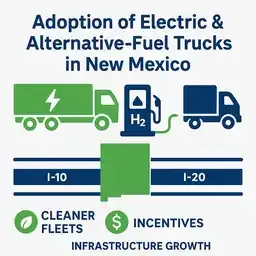
Infrastructure Matters: Availability of charging stations (for BEVs), hydrogen refuelling (in the future), and alternative fuel stations along major freight corridors in New Mexico (I-10, I-25, I-40) will influence adoption feasibility. For example, an analysis estimated build-out of at least 50 alternative-fuel stations along major corridors.
-
Fleet Transition Opportunities: Early-adopter fleets may benefit from grants/incentives, lower operating costs (fuel & maintenance), and improved environmental image.
-
Freight Corridor & Rural Challenges: The long distances, variable terrain, and remote locations in New Mexico pose challenges for range, infrastructure, and reliable operations especially for heavy-haul trucking.
Key Challenges & Considerations
-
Range & Payload Impact: Electric heavy-duty trucks currently have shorter ranges compared to diesel, and the need for charging/downtime must be built into operations.
-
Infrastructure Gaps: Although New Mexico is building out EV infrastructure, heavy-duty truck chargers and alternative-fuel stations still lag compared to diesel fueling access.
-
Upfront Costs: Acquisition cost for electric/alternative-fuel trucks remains higher than diesel equivalents, though incentives and total cost of ownership improvements help mitigate this.
-
Operational Fit: Freight operations must align with where zero-emission trucks perform best (regional routes, predictable return to base, overnight charging) rather than long-haul “cross-country” routes until infrastructure matures.
-
Diesel Still Dominant: According to national data, while alternative-fuel heavy trucks are increasing, diesel remains the dominant powertrain.
What’s Ahead & What Carriers Should Do
-
Monitor regulation timelines: Understand when new zero-emission truck sale requirements will kick-in, and plan fleet renewal accordingly.
-
Assess route suitability: Evaluate your routes in New Mexico for range, charging/refuelling access, downtime tolerances, and vehicle availability.
-
Seek incentives/grants: Leverage state and federal programs for alternative fuel vehicles and infrastructure (e.g., EMNRD programs).
-
Plan infrastructure & partnerships: Work with utilities, chargers, and possibly hydrogen fuel providers to ensure access — consider public and private infrastructure build-out.
-
Transition strategy: For many fleets, a phased approach (e.g., start with regional/local routes, shorter hauls, fleet corner routes) may make sense before moving to more demanding operations.
-
Track total cost of ownership (TCO): Beyond fuel savings, include maintenance, downtime, driver training, infrastructure, and residual value in fleet decisions.