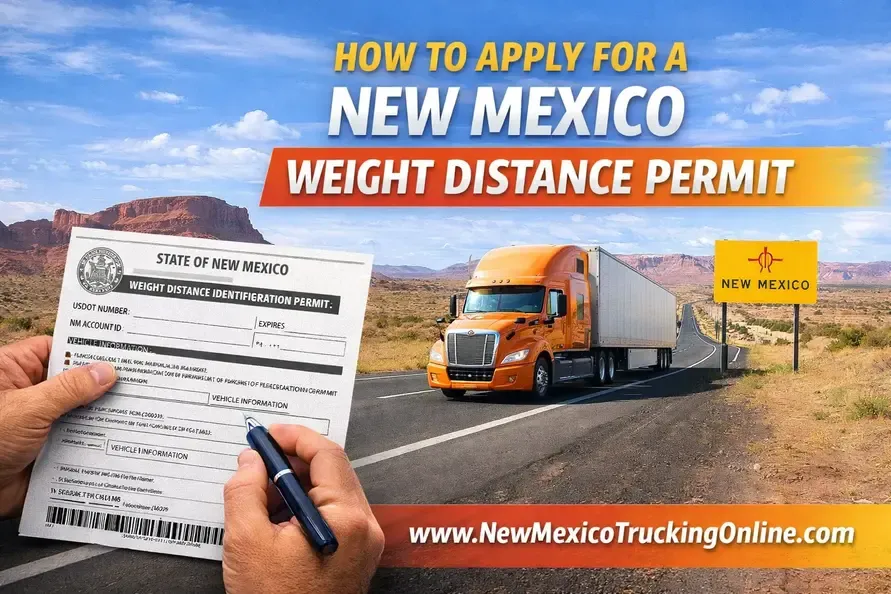
What Is a New Mexico Weight Distance Permit?
The Weight Distance (WD) Permit is required for commercial trucks operating on New Mexico highways that exceed certain weight thresholds. Instead of paying traditional registration fees, carriers pay a tax calculated by vehicle weight and miles traveled in New Mexico.
Key points:
-
Applies to trucks over 26,000 lbs GVWR.
-
Required for both intrastate and interstate carriers.
-
Must be renewed annually.
Who Needs a WD Permit?
You need a New Mexico WD Permit if you operate:
-
Trucks, tractors, or trailers over 26,000 lbs GVWR.
-
For-hire carriers operating in New Mexico.
-
Vehicles registered outside New Mexico but traveling on state highways.
Exemptions:
-
Certain government vehicles
-
Farm and agricultural vehicles under weight limits
-
Vehicles registered under IRP with NM apportioned plates
Step-by-Step Guide to Apply
1. Gather Required Information
Before applying, collect:
-
Vehicle information (VIN, make, model, weight)
-
USDOT number and MC number
-
Business and contact information
-
Mileage estimates in New Mexico
2. Access the Application Portal
Use the official New Mexico Trucking Online portal to start your application.
3. Complete the Application Form
Enter:
-
Vehicle and fleet details
-
Mileage estimates
-
Owner/operator information
Double-check that all fields match your USDOT and IRP records to avoid processing delays.
4. Calculate and Pay Fees
Fees are based on:
-
Vehicle weight
-
Estimated miles traveled
-
Permit type (annual vs. temporary)
Payment can typically be made online via credit card or electronic check.
5. Submit and Print Your Permit
After processing:
-
Download or print your WD Permit
-
Keep a copy in the vehicle at all times while operating in New Mexico
Tips for a Smooth Application
Ensure all vehicle weights are accurate
Estimate mileage conservatively to avoid underpayment penalties
Apply before your first trip in New Mexico
Track fleet changes and update the permit as needed
Penalties for Non-Compliance
Operating without a valid WD Permit can result in:
-
Fines and citations at weigh stations
-
Delayed shipments and enforcement actions
-
Back taxes based on estimated mileage